
2 minutes ago
- copy link
There are 40,000 fragments larger than 10 centimeters present in space.
According to ISRO’s ‘Indian Space Situational Awareness Report-2025’, last year India had to be very cautious to keep its satellites safe. In 2025, more than 1.5 lakh alerts were issued for ISRO satellites.
These alerts came from the US Space Command, which were analyzed by Indian scientists with more accurate orbital data. These figures clearly indicate that Low-Earth Orbit (LEO) has now become dangerously crowded.
To avoid the dangers of collision with space debris, ISRO had to perform ‘Collision Avoidance Maneuver’ 18 times. This was done 14 times for LEO satellites and 4 times for Geo Stationary Satellites (GEO). In these maneuvers, potential collisions are avoided by changing the speed and altitude of the satellite.
Concern: 16 orbit maneuvers for Chandrayaan-2 in 2025
Even considering the future risks, ISRO had to change its orbit maneuver planning 84 times. The plan for Chandrayaan-2’s deep space orbiter was changed twice to avoid collision with NASA’s Lunar Reconnaissance Orbiter. For Chandrayaan-2 alone, 16 orbit maneuvers were carried out in 2025.
ISRO conducted collision avoidance analysis before lift-off for all its 5 launches in 2025. In one case, the launch of the LVM3-M6 mission had to be delayed by 41 seconds to ensure distance from the debris.
12 lakh pieces exist as debris in space
According to the reports of ISSAR 2025 and WEF 2026, space is now becoming a ‘garbage bin’. According to research, there are 40,000 pieces of debris larger than 10 centimeters and about 12 lakh pieces larger than 1 centimeter present in space as debris.
There were 328 launch attempts in 2025, resulting in the deployment of 4,198 satellites and the addition of a total of 4,651 new space objects. Garbage is moving in space at a speed of 28,000 km/hour. Even a small screw can destroy a satellite.
How are other countries protecting satellites?
America: Real-time tracking of over 40,000 debris through advanced radar networks and sensors.
European Space Agency: State-of-the-art collision avoidance software.
China: Huge ground-based telescopes and ‘on-orbit refueling’ technology to move satellites from one orbit to another in space.
Japan: Experimenting with private companies to pull debris back into the Earth’s atmosphere using technologies such as magnetic and electrical wires.
——————————
Read this news also…
Second crew module test of Gaganyaan mission successful: launched from Chinook helicopter from 3 km height; Safe landing in the sea with parachute
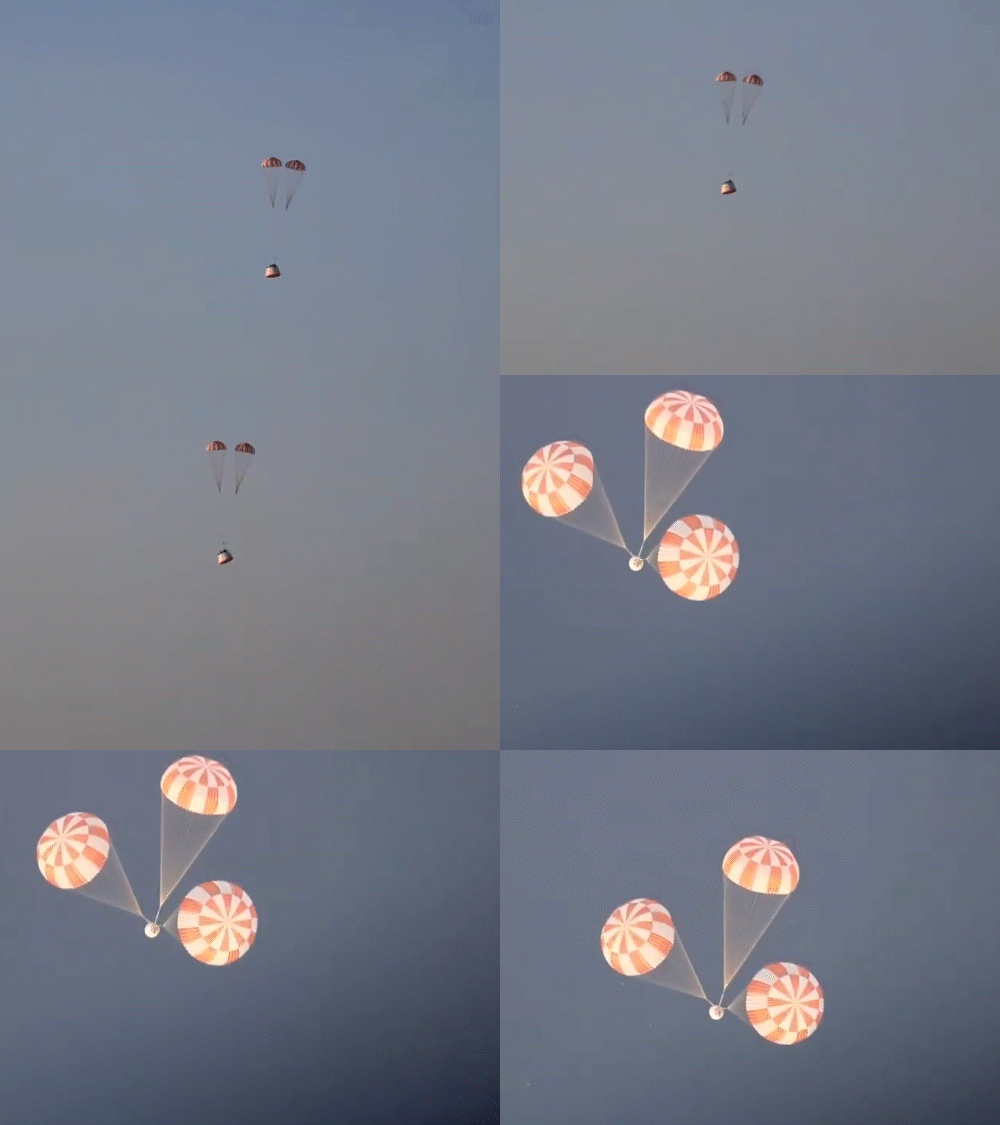
A major success has been achieved in the preparation of India’s first manned space mission Gaganyaan. ISRO successfully completed the second Integrated Air Drop Test (IADT-1) on Friday. Read the full news…

Source link
[ad_3]

