
New Delhi55 minutes ago
- copy link
The case has reached the Supreme Court against two decisions of the Karnataka High Court and the Delhi High Court. Apart from this, many more PILs were filed.
The Supreme Court will hear on Tuesday (September 24) whether a case should be filed against a husband for having forced relations with his wife. A bench of Chief Justice of India (CJI) DY Chandrachud and Justice JB Pardiwala will hear this matter.
The case has reached the Supreme Court against two decisions of the Karnataka High Court and the Delhi High Court. Apart from this, many more PILs were filed. All these will be merged together and heard in the Supreme Court.
According to Exception 2 of Section 63 (Rape) of the Indian Penal Code (BNS), marital rape is not considered a crime. However, the Central Government also has to file a reply on this matter. The Center says that discussions are needed to change the laws.
How did the case of marital rape reach the Supreme Court…
There was a demand for making new laws regarding marital rape for a long time. After the decisions of Delhi High Court and Karnataka High Court in the last two years, the demand for it has increased further. There are two main petitions in the Supreme Court, which will be heard. One petition was filed by the husband, while in the other case, a petition was filed by a woman.
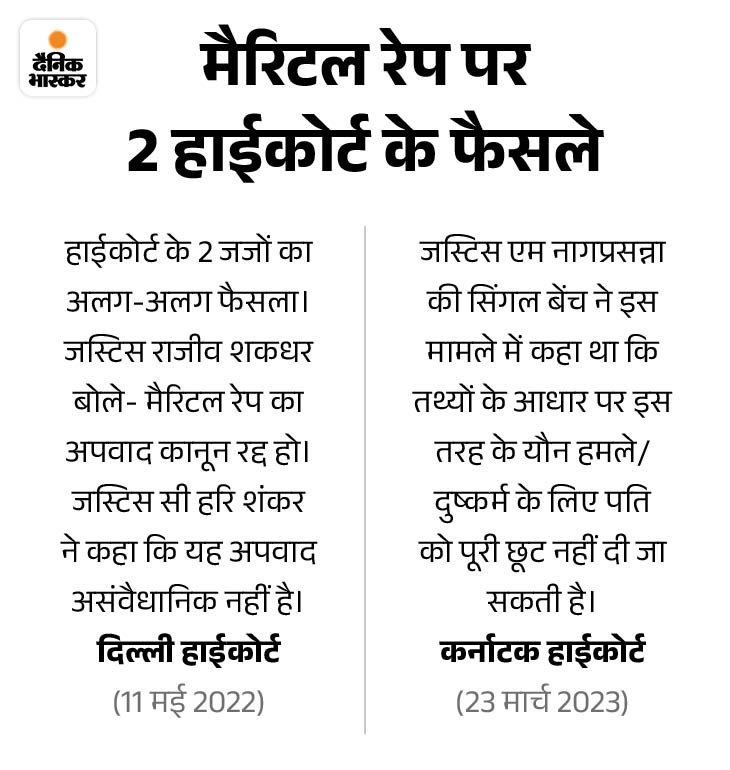
Delhi High Court case: In the year 2022, a woman filed a petition in the Delhi High Court on forced physical relations by her husband. On May 11, 2022, 2 judges of the Delhi High Court gave different verdicts. Justice Rajiv Shakdhar supported the abolition of the exception to marital rape. At the same time, Justice C Hari Shankar said that the exemption given to the husband is not unconstitutional and is based on a sensible difference.
Karnataka High Court case: A husband had approached the Karnataka High Court on the allegations of rape leveled by his wife. On 23 March 2023, the Karnataka High Court refused to drop the rape charges leveled against the husband. The High Court refused to accept the exception in this case. A single bench of Justice M Nagaprasanna of the Karnataka High Court had said in this case that on the basis of facts, the husband cannot be given complete exemption for such sexual assault / rape.
What is marital rape, what is the law in India
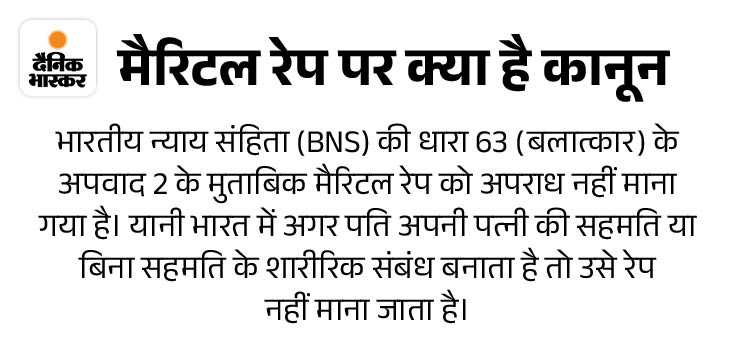
Marital rape is when a husband forcibly has physical relations with his wife without her permission. Marital rape is considered a form of domestic violence and sexual harassment against the wife. Marital rape is not considered a crime in India.
The petitioners have given 3 arguments for removing the exception from section 63 of the BNS

The Indian government has refused to consider marital rape a crime In 2016, the Modi government rejected the concept of marital rape. The government said that it cannot be implemented in the Indian context due to various reasons such as illiteracy, poverty, many social customs, values, religious beliefs and the society’s mindset of considering marriage as a sacrament.
In 2017, the government opposed the removal of the legal exemption to decriminalise marital rape. The government argued that criminalising marital rape would destabilise the institution of marriage and would be used by wives to punish their husbands.
Last year, during the hearing on marital rape in the Delhi High Court, the Centre had said that just because other countries have declared marital rape a crime, India does not need to do so.
In the 19th century, the law in England recognized marital rape According to Jonathan Herring’s book Family Law (2014), historically, in most parts of the world, the belief was that a husband could not rape his wife because the wife was considered the property of the husband.
Until the 20th century, the laws of America and England believed that after marriage, the rights of the wife are merged with the rights of the husband. With the rise of feminist movements in the early 19th century, the idea also arose that the right of women to consent to sexual relations between husband and wife after marriage is their fundamental right.

Read this news also…
Supreme Court said- watching, downloading child pornography is a crime: Madras High Court’s decision overturned

The Supreme Court on Monday said that downloading and viewing child pornography is a crime under the POCSO and IT Act. A bench of CJI DY Chandrachud, Justice JB Pardiwala and Justice Manoj Mishra delivered the verdict, overruling the decision of the Madras High Court. Read full news…
Source link
[ad_3]

