
- Hindi News
- National
- Former CJI DY Chandrachud On AI In Judiciary | Judge Must Write Verdicts
6 minutes ago
- copy link
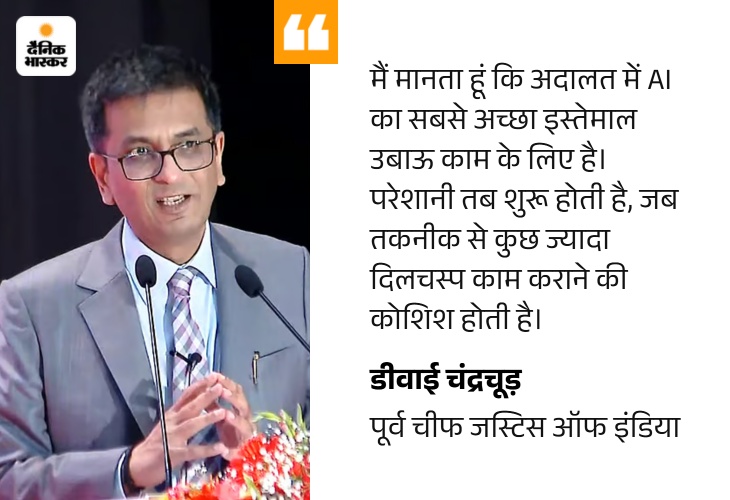
Justice DY Chandrachud was the 50th Chief Justice of India (CJI) – file photo
Former CJI DY Chandrachud said that AI can do the boring and routine work of the courts. But the decision and its reasons should remain the responsibility of the judge. AI can be used for transcription, translation, making lists of cases and finding flaws in documents.
The former CJI said these things in the program ‘AI for All: AI Governance and Trust, The Case for Judicial Access and Empowered India’ held in New Delhi on Saturday.
Chandrachud said, “These AI tools have one thing in common. They do transcription, translation, list of cases and finding loopholes in documents. This is boring work. Most of the time of the courts is spent on this.”
He said, “The tragedy of the Indian judicial system is that judges are spending their time doing what should be the least part of their time. Their focus should actually be on taking decisions quickly.”
AI is creating fake examples
Referring to fake legal citations generated by AI, Chandrachud pointed to two Supreme Court cases. Fake references to judicial decisions were given in these cases.
He said that in one case the trial court of Andhra Pradesh relied on four decisions of the Supreme Court which did not exist.
Later the Supreme Court said that the decision given on the basis of non-existent decisions was not just a mistake but also malpractice.
In the second case, the orders of a tribunal cited actual decisions of the Supreme Court. But fake paragraphs were added in the name of those decisions.
Chandrachud said, “A quote from a law report that does not exist can be caught in 30 seconds. But a fake paragraph added to the original judgment will not be caught in a normal investigation.”
He said that every quotation and translation generated by the machine should be checked by a human being. Records of every use of AI should also be kept.
Proposed rules for AI in courts
The former CJI said that on June 3, the AI Committee of the Supreme Court had issued draft rules for the use of AI in courts. These proposed rules have been made to be applicable from the Supreme Court to the trial court and tribunal. The basis of these rules is human priority, transparency, accountability, data security and judicial independence.
Chandrachud said the draft rules allow the use of AI in case management, transcription, translation and research. However, the use of AI in assessing a person’s bail risk or determining the credibility of a witness would be prohibited.
He said that where someone’s rights or freedom is in question, opaque systems should not be allowed. The proposed rules call for maintaining a register of every AI tool used by the courts. In case of any glitch, a database of incidents will also be created.
Parties who will use AI in their arguments will have to provide information about it. Chandrachud said three issues need to be addressed before finalizing the rules. These include mechanisms to challenge AI-related mistakes, such as mistranslations. He also pointed out the need for training and independent audit of district judges.
Five tests of AI use
Chandrachud also listed five tests for the use of AI in courts. The first test is that the decision should be taken by a human being and should be signed by him. He said the decision was an exercise of public power by a person who has taken oath. He gives reasons for his decisions and remains accountable through the appeals process.
Chandrachud said, “Bhasha Model has not taken any oath. She cannot be asked to explain herself in the higher court. She is not concerned about any innocent person in custody.”
“Let AI find documents, translate them and create summaries. The decision and the reasons for it should be the judge’s own,” he said.
The second test is that a person’s freedom should not be decided by a score of probability. Chandrachud said that in deciding bail, the court has to consider the person present, the charges, the material on record and the circumstances of the case.
He said that the risk score can give some information based on the pattern. But it cannot take the place of individual assessment of the individual. The use of technology should be in accordance with the protection of freedom given in Article 21 of the Constitution.
The third test is whether the parties should be informed about the use of AI in the litigation. “If any tool has been used to translate my evidence or create a summary of my appeal, I should know,” Chandrachud said.
He said that the parties should also get an opportunity to state whether the AI has done something wrong or has done something very wrong. So remember that our translation decisions are reviewed by humans. The translation, which no one checked, is just a rumor about the decision.
The fourth test is that the technology should reach the people standing at the back of the queue. He said, “The strongest use of AI in courts is the decision that reaches a party in Marathi or Assamese on the day of pronouncement. The date of the next hearing can be asked through voice on an ordinary phone.
The fifth test is of data security. Chandrachud advocated for sovereign databases and AI models made in India. None of this is against test technology. Each test reveals what a good judge already does.
Need for technology amid pending cases
Chandrachud also stressed the need for technical assistance in the justice system in view of the large number of pending cases. He cited the statement given by the Law Minister in Rajya Sabha in July. He said that about 5.64 crore cases are pending in the courts of the country.
He told that there are about 15 judges for every 10 lakh people in India. In 1987, the Law Commission had recommended 50 judges for every 10 lakh people. Chandrachud said that on an average, a district court judge handles about 2,200 cases.
Citing the data of India Justice Report, he said that Rs 6.46 is spent annually on legal aid for every person. In most places you won’t even get a cup of tea for that much money.
Technical initiatives going on in courts
Chandrachud also informed about the ongoing technological initiatives in the court. These include AI transcription of arguments in the court. He also mentioned the Supreme Court’s translation tool ‘Suvas’. This tool has translated the judgments into 18 Indian languages.
He said that speech-to-text technology is being used in all the trial courts of Kerala from November 1, 2025 to record the statements of witnesses.
He said that a tool is being tested in collaboration with IIT Madras. This will help in identifying shortcomings in the applications and documents filed in the new court.
Chandrachud also gave advice to people associated with the legal profession. He said that lawyers should read any decision completely before citing it.
Citing the stand of the Bar Council of India, he said that lawyers cannot blame technology for mistakes made in their arguments.

Source link
[ad_3]

