
New Delhi9 minutes ago
- copy link
The Supreme Court questioned the government on the huge difference in the maximum retail price (MRP) of medicines and the prices received by the retailer. The bench of Justice Vikram Nath and Justice Sandeep Mehta asked why the entire system is helping drug manufacturers.
The court described the National Pharmaceutical Pricing Authority (NPPA) as inactive and questioned why the prices of medicines were not being controlled.
The government argued that drug prices in India were among the lowest in the world. On this, the court said that all this is happening in front of the government and asked whether it should be allowed to go on like this.
The Center said its policy is not to control the entire pharmaceutical business. After hearing both the cases, the Supreme Court reserved its decision.
Last 2 hearings in Supreme Court
October 12: Questions on trade margin of anti-cancer drugs also
Earlier during the hearing, the Supreme Court had described the Centre’s response on limiting the trade margin of anti-cancer drugs to 30% of MRP as hardly something to be happy about.
The court had questioned why the government cannot set a limit on the trade margin of other medicines.
The Centre, which has faced severe criticism from the Supreme Court over hospitals charging huge profits on cancer medicines, had said that it has taken an important decision to limit the trade margin on anti-cancer medicines to 30% of MRP.
According to the Centre, this decision is expected to save patients about Rs 2,500 crore annually.
September 29: Supreme Court said – high price of cancer medicines is like genocide
Earlier, during the hearing, the Supreme Court had questioned the Central Government as to why the MRP on a cancer medicine worth Rs 2700 is Rs 27,000. The court expressed displeasure over the prices of medicines and said that this is genocide.
How is the price of medicine decided, 4 points
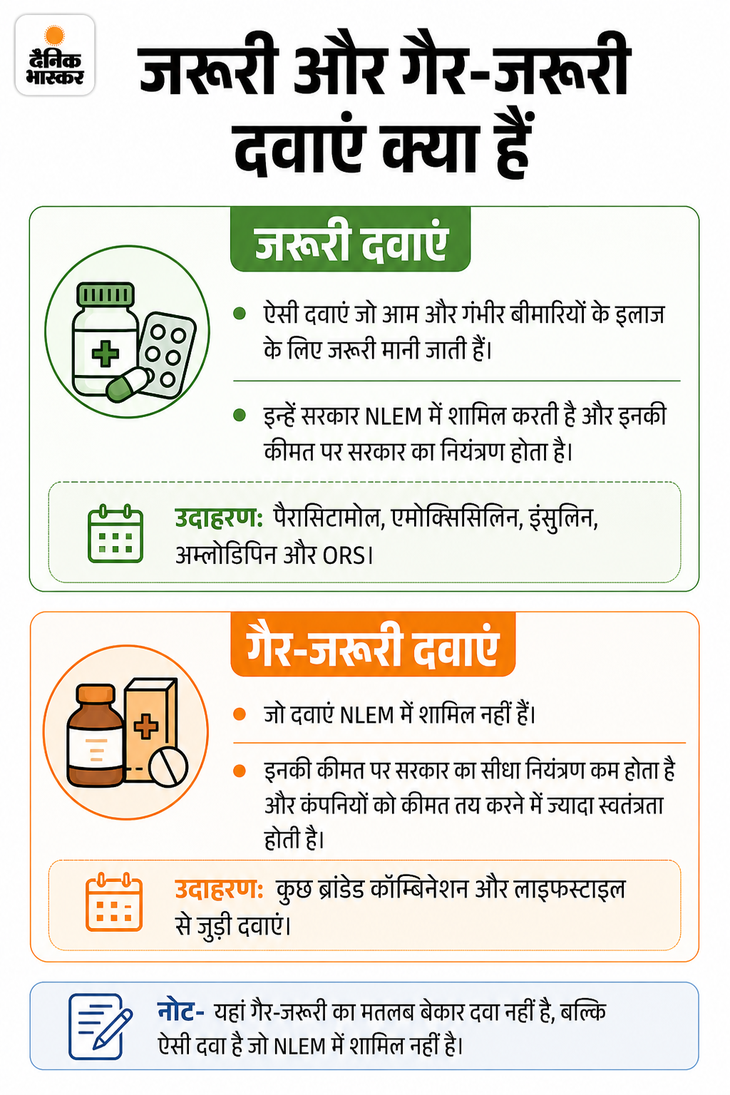
1. Drug Price Control Order (DPCO) controls the prices of essential medicines. Under the DPCO of 2013, the government decides the maximum price of medicines included in the National List of Essential Medicines (NLEM).
2. The maximum limit for essential medicines is decided based on the price of medicines being sold in the market. It is illegal to sell medicine at a higher price than this.
3. The Health Ministry prepares a list of essential medicines considering their safety, effectiveness and price. In this, common diseases and health needs of the people in the country are taken care of.
4. This list is reviewed from time to time and new medicines are added as per need. The government has less direct control over the prices of medicines which are not in this list.

Source link
[ad_3]

