
Raj drove his Maruti Wagon R to the fuel station. He asked the attendant to fill petrol for Rs 2,000 and leaned back against the car to watch the digital display tick over, eyes on the rapidly climbing figures – petrol dispensed and cost.
Below that a second display, the cost of a litre of petrol – Rs 94.77 in Delhi, Rs 101.06 in Chennai, Rs 102.96 in Bengaluru, Rs 103.54 in Mumbai, Rs 105.41 in Kolkata, and Rs 107.5 in Hyderabad. At Rs 94.77 per litre, the attendant dispensed 21.1 litres of petrol. Raj paid and got into his car but, as he drove away, began wondering.
Advertisement – Scroll to continue
‘What did I pay for? If a litre costs Rs 94.77, does that money go to the petrol company, the government? How much was for the petrol itself? How much was tax? Who imposed that tax? And how much has the war in Iran affected petrol price in India?’
All good questions.
Breaking down the cost of petrol
Broadly speaking, the per litre price Raj paid for petrol, includes these components:
- Cost of importing and refining crude oil, and transporting it to fuel stations,
- Central excise duty,
- State taxes, and
- Commission paid to the dealer
The rupee value of each will vary by city and retailer, and changes, whether in individual or multiple components, may or may not affect retail consumers. This depends on the government’s decision to absorb hikes in global oil prices.
For example, on Friday morning the government cut special excise duty by Rs 10 per litre for petrol and diesel, bringing its taxes down to Rs 3 per litre for petrol and making it zero for diesel.
Centre excise duty cut on petrol, diesel
The total amount of excise duty levied by the central government on one litre of petrol was Rs 21.90. This has now come down to Rs 11.90. Similarly, total central excise duty on a litre of diesel has down from Rs 17.8 to Rs 7.8.
Breakup of central taxes on a litre of petrol:
- Basic Excise Duty – Rs 1.4
- Special Additional Excise Duty – Rs 3 (reduced from Rs 13)
- Agriculture Infrastructure & Development Cess – Rs 2.5
- Additional Excise Duty (Road and infrastructure Cess) – Rs 5
Breakup of central taxes on a litre of diesel:
- Basic Excise Duty – Rs 1.8
- Special Additional Excise Duty – 0 (reduced from Rs 10)
- Agriculture Infrastructure & Development Cess – Rs 4
- Additional Excise Duty (Road and infrastructure Cess) – Rs 2
The central excise on petrol and diesel has seen a steady reduction from May 2020.
| Effective date | Petrol (Rs per litre) | Change (Rs per litre) | Diesel (Rs per litre) | Change (Rs per litre) |
| May 6, 2020 | 32.98 | – | 31.83 | – |
| Feb 2, 2021 | 32.90 | -0.08 | 31.80 | -0.03 |
| Nov 2, 2021 | 27.9 | -5 | 21.8 | -10 |
| April 8, 2025 | 19.9 | -8 | 15.8 | -6 |
| Nov 1, 2025 | 21.9 | +2 | 17.8 | +2 |
| March 27, 2026 | 11.9 | -10 | 7.8 | -10 |
Excise Duty On Petrol Cut To Rs 3, Diesel To Zero: Will Fuel Prices Reduce?
The Friday morning reduction in this tax, the third since Feb 2021, could have had a significant impact at the pump but it did not; Raj paid the same Rs 94.77 per litre that he paid last week.
This is because the excise duty cut is meant to help oil marketing companies, i.e., the public sector units that import, refine, and sell petroleum products, offset soaring crude oil prices because of the United States and Israel’s war on Iran.
Let’s break all this down a bit more.
petrol diesel price per litre cost explainer graphic
OMCs’ production costs have “gone through the roof in the past month”, Petroleum Minister Hardeep Singh Puri said on X this morning as he explained why the central government’s excise duty cut is not going to reduce prices.
International crude prices have gone through the roof in the last 1 month from around 70 dollars/barrel to around 122 dollars/barrel. Consequently, petrol and diesel prices for consumers have gone up all over the world. Prices have increased by around 30%-50% in South East Asian…
— Hardeep Singh Puri (@HardeepSPuri) March 27, 2026
This is in part because the price of one barrel of Brent crude – the global benchmark – has gone up dramatically.
On Feb 28, hours before the first US-Israel air strikes hit Iran, it was US$68.13 per barrel. A week later it was at US$81.38 and on March 7 it crossed the US$100 mark.
At US$100 per barrel it crossed a red line for the global energy industry.
Hormuz Shutdown Affects Asia’s Crude Oil Supply, Pipelines Can’t Cover Loss
More specifically, India’s crude basket, i.e., the weighted average price of specific benchmarks – usually Oman, the UAE, and Brent – that approximates to its import mix, has soared.
This has gone up from US$69.01 per barrel in February to US$123.15 as of March 24.
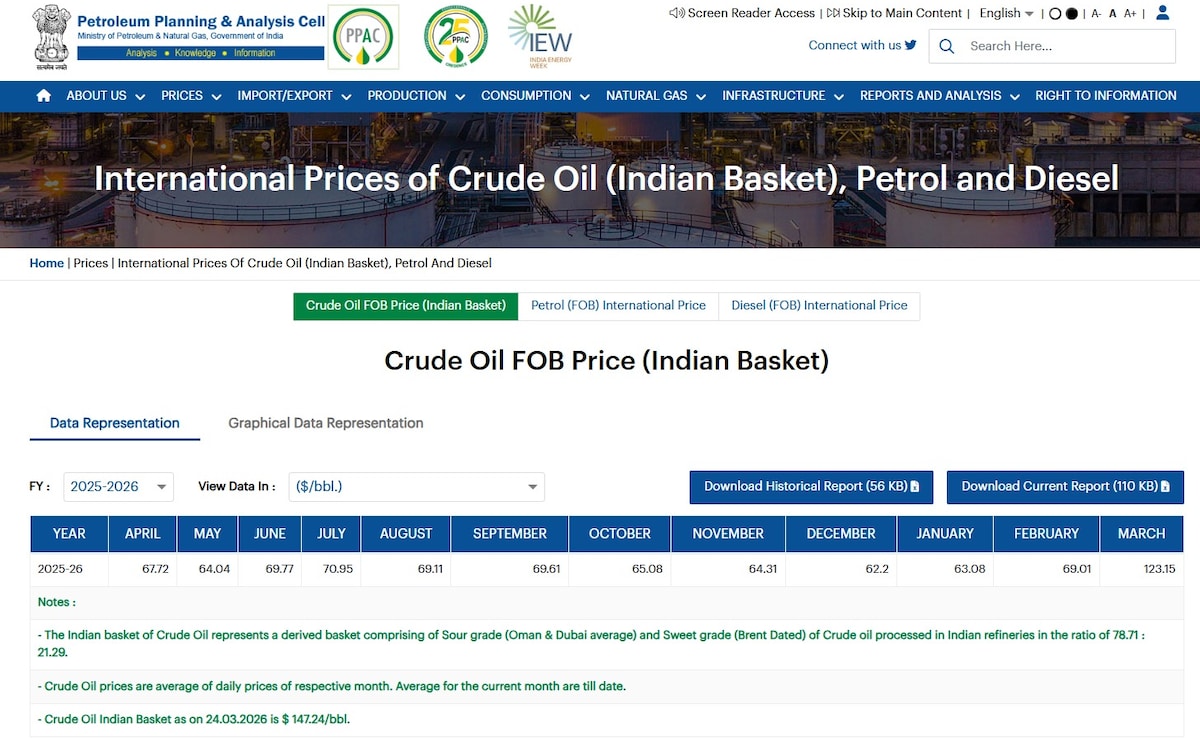
India’s crude basket prices in FY26. Data: Petroleum Planning & Analysis Cell (For high-res image, click here)
OMCs were, therefore, spending up to 78.45 per cent more in procuring crude to refine and sell, leading to staggering per litre losses (estimated by Japanese firm Nomura) of Rs 48.8. The government reduced its taxes to help offset some of this loss.
That, in turn, should help keep OMCs from having to raise petrol and diesel prices.
What about state taxes?
State-imposed duties are the reason petrol and diesel prices vary wildly between two cities.
Each state government adds its own sales or VAT on top of a generally uniform base price and central excise duty. Revenue from this second set of taxes is critical for state governments.
That is why Raj paid Rs 94.77 per litre of petrol in Delhi but, when he drives to Jaipur over the weekend, he could pay as much as Rs 104.72 per litre.
This can often be a point of contention between the centre and states, particularly if the latter administrations don’t match the former’s tax cuts and further reduce pump prices.
Conversely, state governments not ruled by the party in power at the centre sometimes drop their taxes when the central government raises it excise duties.
The centre-state taxes issue can also play key roles in build-up to an election. In this case, with five states – Tamil Nadu, Kerala, Assam, Bengal, and Puducherry – voting next month, and with the global energy market still in shock over the Iran war, fuel prices could become a big issue.
In general petrol attracts a larger tax than diesel because the latter is widely used by public transport and freight systems, and farmers, and even a marginal increase has a pronounced ripple effect through the economy.
What about the other component?
Dealer commission is typically around Rs 2.5 to Rs 4.5 per litre and covers costs like owner (in the case of privately-owned pumps) profit margin, wages of attendants, station and equipment maintenance, and other overheads.
This figure is generally capped, i.e., it is controlled by OMCs, and periodically reviewed.
Variations in this component are due to factors like location of the fuel station (more remote locations may charge higher commissions) and the exact negotiated rupee-per-litre margin.
So what does all this mean?
That petrol or diesel prices are determined by several factors, domestic and international.
The war in Iran has driven Brent crude up to a nearly four-year record high.
And this, analysts have said, has contributed to increased costs worldwide. In the US, for example, soaring Brent crude has added an estimated 15 to 25 per cent to fuel prices compared to those in late-February. European retailers have increased prices by a similar proportion.
Many parts of Africa are net importers and have been as badly affected by the war in Iran and the Hormuz blockade. And this week in Southeast Asia, Philippines President Ferdinand Marcos Jr declared a national energy emergency in response to “imminent danger” due to the Iran war.
Source link
[ad_3]

