
Last Updated:
9 cops got death sentence for custodial death of P Jayaraj and his son, Bennix, in Sathankulam in Tamil Nadu, over violation of Covid norms. News18 explains law, what next




Police escort a convict outside a court premises in connection with the Sathankulam custodial death case, in Madurai on Monday. (PTI)
In a landmark judgment, a Madurai court on Monday handed the death penalty to nine police personnel in the sensational 2020 Sathankulam custodial death case. The father-son duo, P Jayaraj and J Bennix, died after they were assaulted by the convicted policemen in Sathankulam in Thoothukudi district of Tamil Nadu for keeping their mobile shop open in violation of COVID-19 norms.
Can police officers in India can be sentenced to death if torture in custody results in the death of the victim? News18 explains
WHAT WAS THE 2020 SATHANKULAM CUSTODIAL DEATH CASE?
“The case dates back to June 19, 2020, wherein the accused police officials of Santhankulam PS had wrongfully confined P Jeyraj. His son Benniks, who went to police station to enquire as to why his father was detained was also confined after some altercation,” a spokesperson of the Central Bureau of Investigation (CBI), which probed the case, said in a statement.
Thereafter, the father and the son were mercilessly beaten and brutally tortured by the accused police officials on the intervening night of June 19 and 20, 2020, the spokesperson said.
“Benniks succumbed to injuries on 22nd and Jeyraj on 23rd June. The case was transferred to CBI for fair investigation by the Tamil Nadu government.
“After a thorough investigation, CBI filed charge sheet against… 9 accused persons within 90 days,” the spokesperson said.
Following a massive public outcry, the Madurai Bench of the Madras High Court took note of the case. A total of 105 witnesses were examined over five years. Of the initial 10 accused, Special Sub-Inspector Pauldurai died during the trial due to health complications.
WHO ARE THE NINE CONVICTED COPS?
The nine individuals sentenced to death are:
- S. Sridhar (former Inspector)
- K. Balakrishnan and P. Raghu Ganesh (Sub-inspectors)
- S Murugan and A Samadurai (Head constables)
- M Muthuraja, S. Chelladurai, X. Thomas Francis, and S. Vailmuthu (Constables).
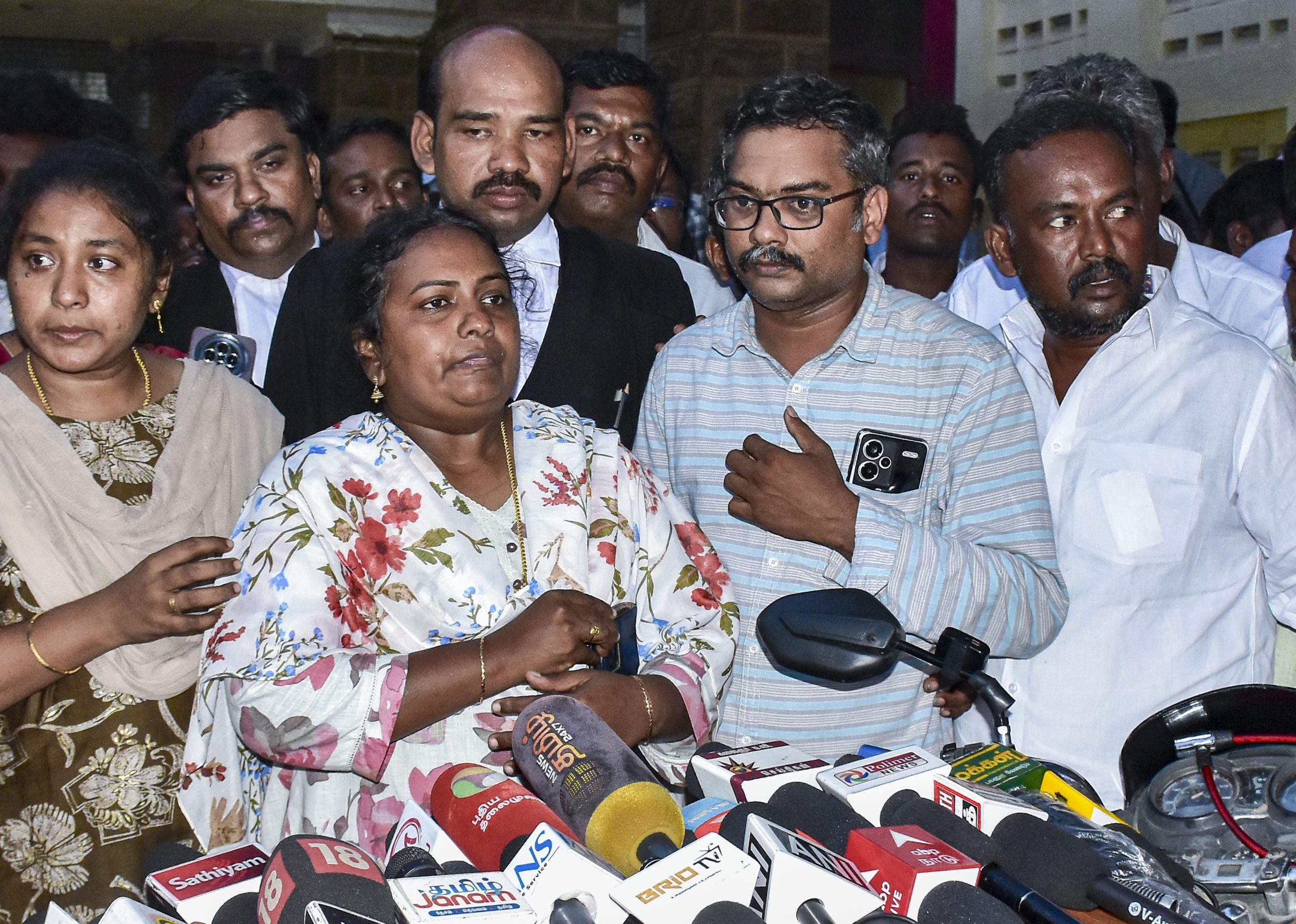
WHAT DID THE COURT SAY? WHY THE Rs 1.4 CRORE COMPENSATION?
First Additional District and Sessions Judge G Muthukumaran classified the Santhakulam case as the rarest of rare, observing that those entrusted with protecting the public had committed a crime that shook the collective conscience of society. The court sentenced all nine convicted police personnel to death for the murders of Jayaraj and Bennix. The convicts include former inspector S Sridhar, former sub-inspectors Balakrishnan and Raghu Ganesh, and head constables Murugan and Saamidurai.
In addition to the capital punishment, the court imposed a combined fine of Rs 1.40 crore on the convicts to be paid as compensation to the victims’ family.
While pronouncing the quantum of sentence, the judge said police are meant to protect the common man, and when they become the perpetrators of such brutality, the law must act as a deterrent. It also noted that by killing both the father and the son at once, police had uprooted the very foundation of a family. The judge stressed that the punishment must be severe enough to ensure such horrors never recur.
WHAT NEXT FOR THE NINE POLICEMEN?
Following this landmark trial court verdict, the legal process will now enter the next phase of appeals and confirmation: Under Indian law, a death sentence passed by a trial court cannot be executed until it is confirmed by the High Court. The Madurai court’s ruling will undergo a mandatory re-examination by the Madras High Court. The High Court will review the entire trial record, evidence, and conviction to decide whether to uphold, commute, or overturn the sentence.
The appeals
The nine convicted officers, including the former inspector and several sub-inspectors, are expected to exercise their legal rights to challenge the verdict. The convicts will likely file appeals against both the conviction and the sentence in the Madras High Court. If the High Court upholds the death penalty, the convicts have the right to approach the Supreme Court of India. Even if the Supreme Court upholds the sentence, they can file review petitions and eventually a curative petition as a last judicial resort.
Clemency and mercy petitions
Once all judicial remedies are exhausted, the convicts can seek executive clemency. They can file mercy petitions before the Governor of Tamil Nadu (Article 161) and the President of India (Article 72).
Compensation and fines
The court has ordered a total fine of ₹1.40 crore to be paid by the convicts to the victims’ family. If the convicted officers fail to pay, the court has directed that their properties be confiscated and sold to raise the compensation amount.
WHAT IS THE LEGAL BASIS FOR THE DEATH PENALTY?
In India, the death penalty for police officers is primarily governed by the following provisions:
Section 302 of the IPC / Section 103 of the BNS: If a police officer is found liable for the death of a suspect due to torture, they are charged with murder. The punishment for murder includes life imprisonment or the death penalty.
“Rarest of Rare” Doctrine: The Supreme Court has observed that murder by police officers in custody falls into the category of the “rarest of rare” cases, which justifies the death sentence as the ultimate deterrent.
LANDMARK CASES RELATED TO CUSTODIAL TORTURE
While historically rare, courts have increasingly awarded capital punishment to send a strong message against state-sponsored violence:
Thiruvananthapuram Case (2018): A special CBI court sentenced two police officers to death for the 2005 custodial murder of Udayakumar, marking one of the first such instances in Kerala.
If the torture does not result in death, officers face lesser but still significant penalties:
Voluntary Hurt (Section 330 IPC): Punishable by up to 7 years in prison for causing hurt to extort a confession.
Grievous Hurt (Section 331 IPC): Punishable by up to 10 years in prison for causing severe injury (like fractures) to extort information.
Wrongful Confinement (Section 348 IPC): Punishable by up to 3 years for illegal detention to obtain a confession.
ARE THERE ANY PROCEDURAL SAFEGUARDS TO PREVENT CUSTODIAL DEATHS?
To ensure accountability, the law mandates specific procedures in cases of custodial death:
Mandatory Inquiry: Under Section 176(1) of the CrPC (now Section 196 of the BNSS), a Judicial Magistrate must conduct an inquiry into every death occurring in police custody.
Medical Examination: Every arrested person has the right to be examined by a medical practitioner to record any signs of torture.
DK Basu Guidelines: The Supreme Court’s landmark ruling in DK Basu vs State of West Bengal mandates 11 specific requirements for arrests, including informing relatives and maintaining an inspection memo.
KEY FAQs
Can police officers in India get the death penalty for custodial torture?
Yes, but only in extreme cases. If custodial torture leads to death, officers can be charged under Indian Penal Code Section 302, which allows for the death penalty or life imprisonment.
What laws deal specifically with custodial violence?
Custodial torture is addressed under provisions like Indian Penal Code Section 330 and Indian Penal Code Section 331, along with constitutional protections under Article 21 of the Constitution of India.
Has India made a separate anti-torture law?
India has not yet enacted a standalone anti-torture law, although it has signed (but not ratified) the United Nations Convention Against Torture, and courts have issued strict guidelines against custodial abuse.
With agency inputs
April 07, 2026, 1:55 PM IST
Read More
Source link
[ad_3]

