
New Delhi:
The A-10 Thunderbolt II was built to kill Soviet tanks rolling through European plains. Decades later, it is hunting fast-attack boats in one of the world’s most strategically fraught waterways, Strait of Hormuz.
General Dan Caine, chairman of the US Joint Chiefs of Staff, confirmed at a Pentagon briefing on Thursday that A-10s are now conducting strafing runs against small watercraft in the strait as part of Operation Epic Fury against Iran, now in its fourth week.
The US Central Command (CENTCOM) has separately noted that the aircraft can loiter for hours over a target area, ready to execute on short notice. The deployment is doing more than sinking boats. It is reopening a decade-long argument about whether the American military is making a strategic error in pushing to retire the aircraft, often described as ugly-looking.
The A-10 earned its reputation not in the air, but close to the ground, in the chaos of close air support (CAS) where troops in contact with the enemy needed something overhead that could absorb punishment, linger over the battlefield, and deliver accurate, sustained fire.
Its GAU-8 Avenger rotary cannon fires depleted uranium rounds at roughly 3,900 per minute. Its airframe was designed around that massive, powerful gun. Redundant hydraulics, a titanium “bathtub” protecting the pilot, and the ability to fly on a single engine gave it a survivability that faster, sleeker aircraft could not replicate at low altitude and low speed.
In the Gulf War and through two decades in Afghanistan and Iraq, ground commanders came to trust it in a way they never fully extended to supersonic jets, aircraft that arrived fast, departed fast, and were not always visible when things went wrong.
Photo Credit: US Air Force
The US Air Force has wanted to retire the A-10 for years, arguing the savings would allow a pivot toward competition with China and Russia. The F-35 was positioned as its replacement in the close air support role, a pitch that internal testing has since complicated significantly, with assessments questioning whether the fifth-generation fighter is a good substitute.
The US’ most recent National Defence Authorization Act temporarily blocked large-scale divestment, capping the A-10 fleet floor at 103 aircraft until the USAF submits a detailed retirement plan to the US Congress. The USAF has not publicly indicated whether that timeline has changed.
Dan Grazier of the Stimson Centre says the Hormuz operations make the retirement case of the A-10 harder to sustain. A weapons system designed purely around military effectiveness tends to outlast the doctrines that tried to replace it, Grazier told the website Defense One in an exclusive interview.
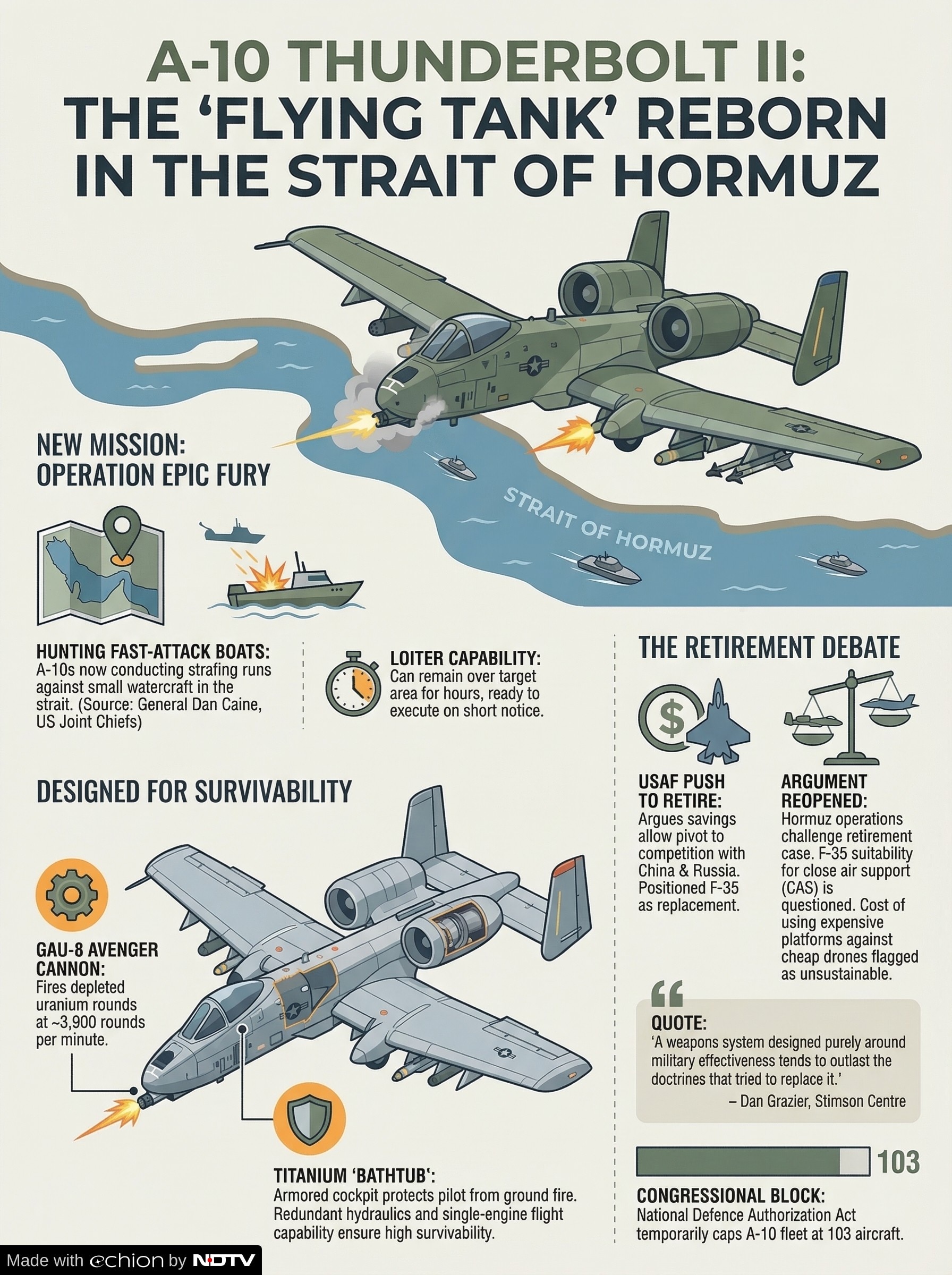
While fourth- and fifth-generation fighters have degraded Iranian air defences, analysts have flagged the cost of deploying expensive platforms against cheap drones as financially unsustainable over any extended campaign.
An F-35 made an emergency landing during a combat mission over Iran earlier this week. On the same day, Iran released footage claiming it had struck one. Meanwhile, the A-10 ‘Warthog’ was strafing boats.
Source link
[ad_3]

