
New Delhi3 minutes ago
- Copy link
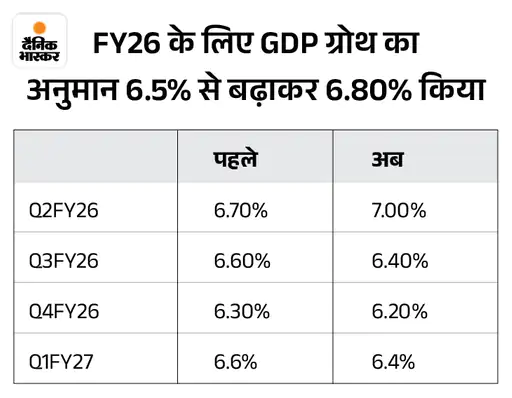
The World Bank has increased India’s GDP growth to 6.5% on October 7 for FY 2025-26. In April, the World Bank reduced India’s development estimate for 2025-26 from 6.7% to 6.3%.
The World Bank says that due to the continuous strength in consumption, India will remain the fastest growing big economy in the world. Also, the change in GST will also support economic activities.
However, in the report, India’s growth rate of 2026-27 has been reduced to 6.3%. Earlier, the growth rate for FY27 was estimated at 6.5%. The World Bank has explained the reason for the US 50% tariff.
According to the World Bank, this high tariff will have a bad effect on India’s exports, so the growth rate for FY27 has been reduced slightly.
RBI predicts 6.8% economy growth
Earlier, RBI also increased the country’s GDP growth from 6.5% to 6.8%. The decision was taken in the meeting of the Monetary Policy Committee from 29 September to 1 October. RBI Governor Sanjay Malhotra gave this information on 1 October.
What is GDP?
GDP is used to track economy health. It shows the value of all goods and service within a fixed time within the country. In this, foreign companies that are produced within the country’s border are also included.
There are two types of GDP
There are two types of GDP. Real GDP and Nominal GDP. In real GDP, the calculation of goods and service values is performed at the value or stable price of the base year. Currently, the base year is 2011-12 for calculating GDP. At the same time, the calculation of nominal GDP is done at the current price.
How GDP is calculated?
A formula is used to calculate the GDP. GDP = c+g+i+NX, here C means private conjpction, G means government spending, I mean investment and NX means net export.
Who is responsible for GDP’s grip?
There are four important engines to reduce or increase GDP.
1. You and us- The more you spend, it contributes to our economy.
2. Business growth of private sector- It contributes 32% to GDP.
3. Government Expenditure- This means how much the government is spending in producing goods and services. It contributes 11% to GDP.
4. Net Demand- For this, India’s total exports are reduced by total imports, as India has more imports than exports, so its impact is negative on GPD.
Source link
[ad_3]

