
New Delhi21 minutes ago
- copy link
Now GST registration for small and low risk businesses will be available in just 3 business days. The central government has launched a new GST registration scheme for small and medium traders from today (November 1). The benefit of the new scheme will be available to those traders whose monthly GST is less than Rs 2.5 lakh.
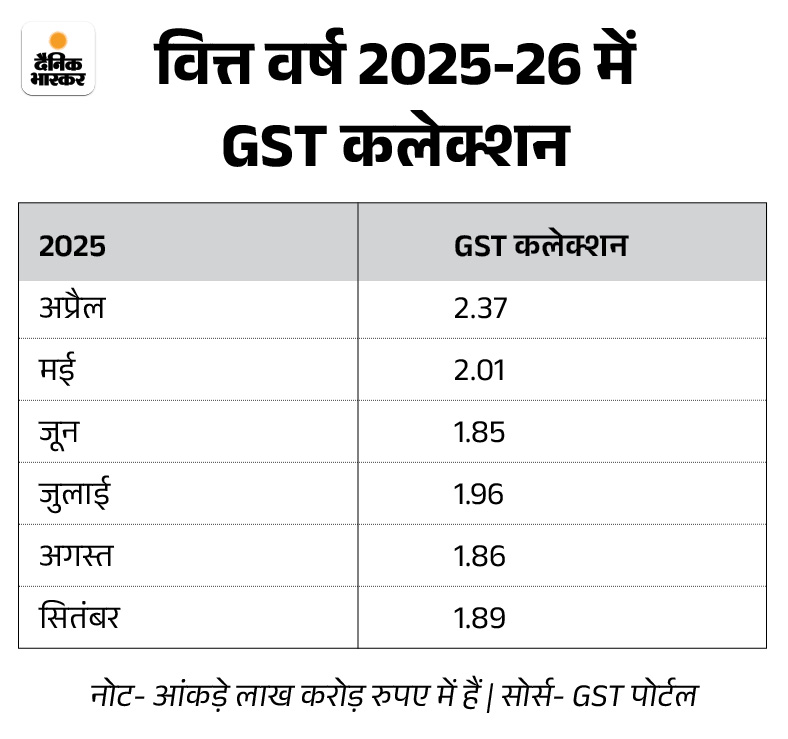
At the same time, the Central Government has today released the figures of GST collection in October. Rs 1.96 lakh crore has been collected from Goods and Services Tax (GST) in October. There has been an increase of 4.6% on annual basis.
According to the data, a year ago i.e. in October 2024, the government had collected Rs 1.87 lakh crore GST. Whereas compared to last month August, the collection of September has increased by Rs 3 thousand crores.
Rs 1.89 lakh crore GST was collected in September, an annual increase of 9.1%. Earlier, a record Rs 2.37 lakh crore was collected as GST in April 2025 and Rs 2.01 lakh crore in May.
96% new applicants will get benefit
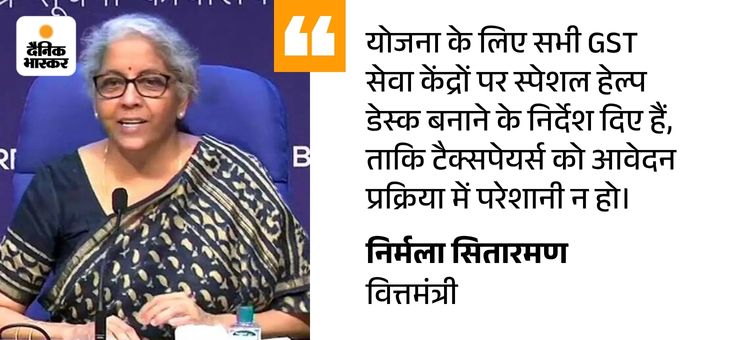
Finance Minister Nirmala Sitharaman said during the inauguration of CGST building in Ghaziabad that this new scheme will benefit about 96% of new applicants. He said that the aim of the department is that there should not be any delay or hindrance in this process.
Understand the new GST registration in 3 questions…
What is the new process and who will benefit?
answer: This scheme was approved in the GST Council meeting held in September. The Simplified GST Registration Scheme will be availed by small or low risk businessmen who are identified by the GST system based on its data analysis or who self-declare that their monthly output tax liability does not exceed Rs 2.5 lakh including CGST, SGST/UTGST and IGST.
The applicant will only have to give a self-declaration or the GST system itself will place it in the low-risk category. At present more than 1.54 crore businesses are registered under GST. This new route will cover new applicants faster. It will be easy for small shopkeepers and startups.
Why did this change happen?
answer: Small businesses faced problems due to delays in the registration process. Now PAN-based registration can be done in 3 days. GST Council approved it and supported small businesses.
How to apply?
answer: The process has been started from today. Applicants should choose the low-risk route by visiting the GST portal. Give self-declaration. Visit the help desk for guidance.
Anytime Exit Facility This is a voluntary scheme, that is, businessmen can adopt it as per their wish and can also opt out of it if needed. At present more than 1.54 crore businesses are registered under GST in the country.
New GST rates were implemented from 22 September
Earlier, from September 22, GST has been implemented on essential goods only in two slabs 5% and 18%. The government has done this to simplify the tax system. Due to this, common essential items like UHT milk, cheese, ghee and soap-shampoo along with AC, car have also become cheaper.
The decision on this was taken in the 56th meeting of the GST Council. Finance Minister Nirmala Sitharaman had given this information on September 3.
GST collection shows the health of the economy
GST collection is an important indicator of economic health. Higher collections indicate strong consumer spending, industrial activity and effective tax compliance.
In the month of April, businesses often clear year-end transactions from March, leading to an increase in tax filings and collections. KPMG National Head Abhishek Jain said that the highest ever GST collection reflects the strong domestic economy.
GST was implemented in 2017
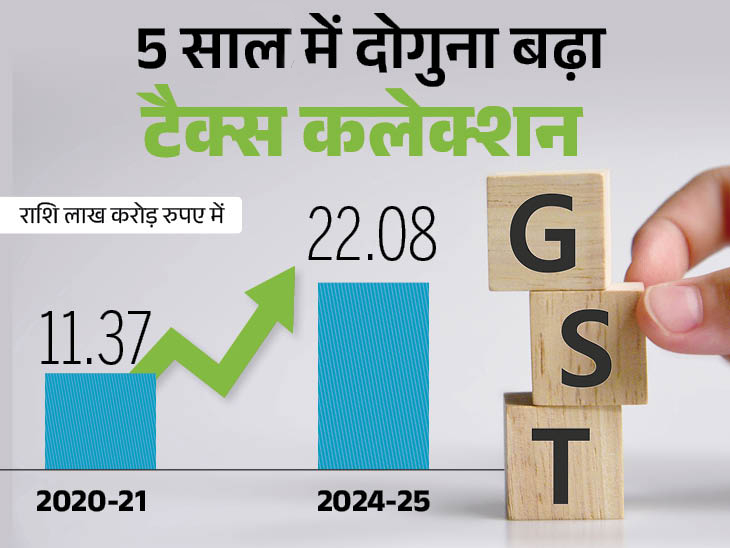
The government implemented GST across the country on July 1, 2017. After this, 17 taxes and 13 cesses of the Central and State Governments were removed. On completion of 7 years of GST, the Finance Ministry posted about the achievements made during the last seven years.
GST is an indirect tax. It was implemented in 2017 to replace various indirect taxes like VAT, service tax, purchase tax, excise duty. GST has four slabs of 5, 12, 18 and 28%.
GST is divided into four parts:
- CGST (Central GST): Collected by the Central Government.
- SGST (State GST): Collected by state governments.
- IGST (Integrated GST): Applicable on interstate transactions and imports, divided between the central and state governments.
- Cess: An additional fee imposed on specific goods (e.g., luxury items, tobacco) to raise funds for a specific purpose.
Source link
[ad_3]

