
Mumbai54 minutes ago
- copy link
The Reserve Bank of India (RBI) is going to auction or sell (re-issue) four government securities (bonds). Their total value is Rs 32,000 crore. The auction will take place on October 31 (Friday) and its settlement will take place on November 3 (Monday).
Government securities are tradable debt instruments issued by the central or state governments, through which the government raises funds for public expenditure.
- These are considered to be the safest investments due to the sovereign guarantee of the Government of India.
- G-Secs are fixed-income investments, which provide income to investors through regular interest and return the principal amount on maturity.
- The funds raised from these bonds are used by the government for infrastructure projects, development programs or other public expenditure.
- Investors get fixed interest till maturity, making G-Secs a preferred option for risk-averse investors seeking stable and safe returns.
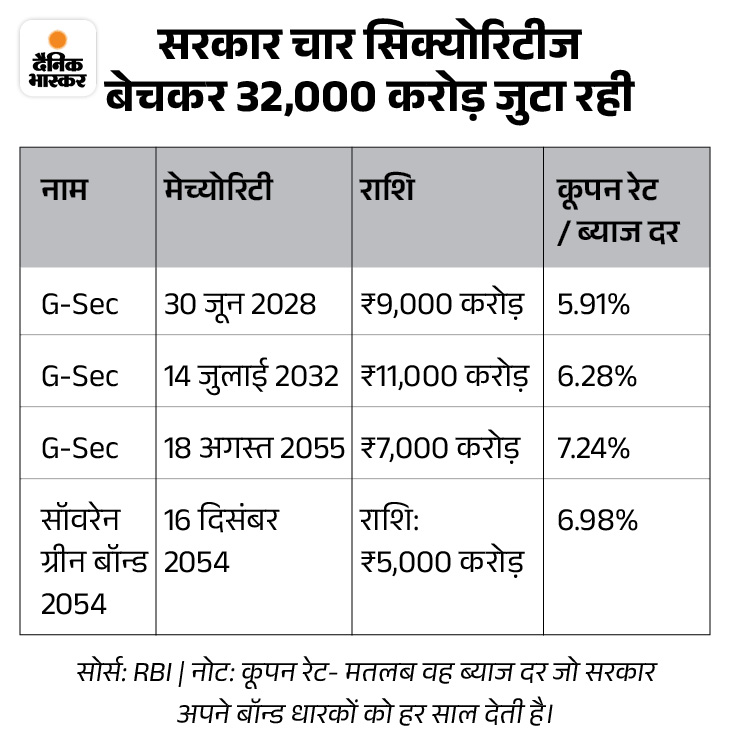
Extra subscription reserve of Rs 2000 crore
The government is keeping an additional subscription of Rs 2000 crore for this, so that if the market demand increases, the total amount can be increased further. This auction will be held through ‘Multiple Price Method’ at the RBI office in Mumbai. This means that different bidders will receive the bonds at the price they bid.
How to bid?
Primary Dealers can submit bids for Additional Competitive Underwriting (ACU) from 9:00 am to 9:30 am on the day of auction. Further, RBI informed that these securities will be available for “when issued” trading from October 28 to October 31, 2025. This allows investors to trade the securities before the actual issue, thereby knowing the price sooner.
What are competitive and non-competitive bids?
Competitive and non-competitive bids will have to be submitted electronically through RBI’s core banking solution (e-Kuber system). RBI said that the results of the auction will be declared on the same day and successful bidders will have to make the payment by November 3, 2025.
- Competitive Bids: These are usually submitted by large financial institutions, which indicate at what yield or price they are willing to buy securities. Their allocation depends on the cut-off yield decided in the auction.
- Non-Competitive Bids: These are for small investors and qualified institutions. They do not need to declare yield or price, they get securities at the weighted average price fixed in the auction.
Now answers to three questions…
Question 1: How will this benefit the common man?
Answer: The government gets money from the auction of government securities, which is spent on things like roads, schools, hospitals. This increases employment, improves facilities and ultimately provides better infrastructure to the common man. Besides, it also provides an opportunity for safe investment, where even small investors can earn fixed interest by investing a little money.
Question 1: What effect will this have on inflation?
Answer: RBI controls money in the market through such auctions, so that inflation does not increase much. If the government sells more bonds, there is less excess money in the banking system, which helps control inflation. Generally, this keeps the economy stable and the prices of goods remain under control.
Question 1: How can a small investor benefit from this?
Answer: Small players can participate through non-competitive bid – simply apply through RBI’s e-Cuber system or through bank/post office. You will get bonds at average prices, fully protected by government guarantee. This provides regular interest, which can give slightly better returns than FD.
————————
Read this news also…
Gold became cheaper by ₹ 1,913 and silver by ₹ 1,631: Gold price decreased by ₹ 10,420 and silver by ₹ 25,830 in 8 days, know 3 reasons

There is a fall in the prices of gold and silver today i.e. on 28th October. According to India Bullion and Jewelers Association (IBJA), the price of gold has fallen by Rs 1,913 to ₹ 1,19,164. Earlier its price was Rs 1,21,077 per 10 grams. At the same time, silver fell by Rs 1,631 to ₹ 1,43,400 per kg. Yesterday its price was ₹1,45,031 per kg.
Source link
[ad_3]

