
Last Updated:
A host nation warning a qualified team not to come? Trump’s remarks about Iran’s men’s football team reveal his hypocrisy and FIFA’s uneasy double standards on politics in football




US President Donald Trump joined by FIFA president Gianni Infantino (R) holds the World Cup Trophy (AFP)
Football likes to pretend it lives in a bubble. But every once in a while, reality barges in and kicks the door down.
The latest episode? The looming possibility that Iran might boycott the 2026 FIFA World Cup, a tournament co-hosted by the United States, Canada and Mexico, amid an escalating war between Washington and Tehran.
And, predictably, the messaging around it has been nothing short of a masterclass in contradiction.
Just days after FIFA president Gianni Infantino confidently relayed assurances from Donald Trump that Iran would be welcome at the World Cup, Trump himself appeared to undercut the sentiment.
Posting on his Truth Social platform, the U.S. president declared that while the Iran men’s national football team was technically “welcome,” it might not be “appropriate” for them to attend — allegedly for their “life and safety.”
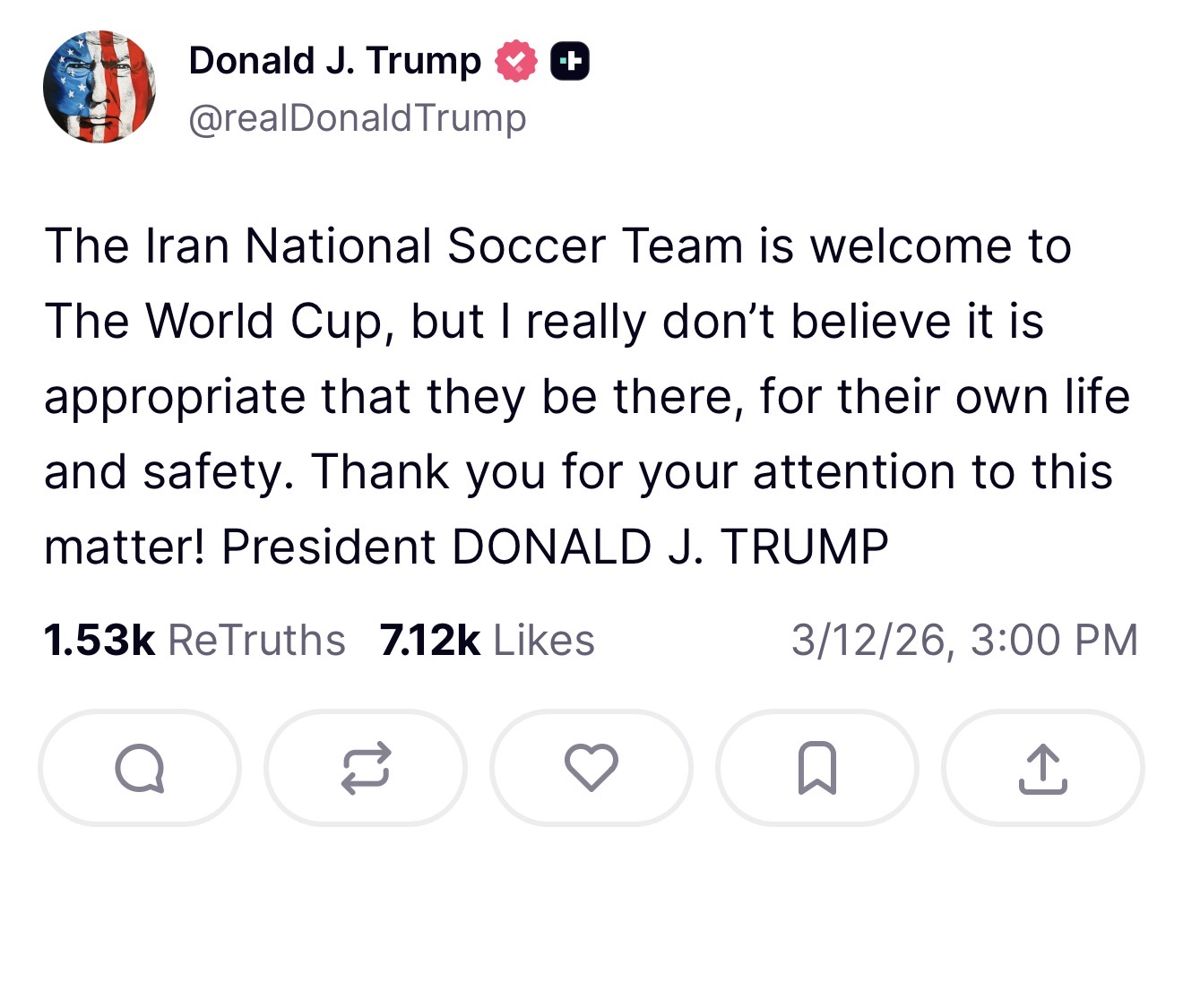
It’s a curious concern — or rather, an underhanded threat — coming from the leader of the very country hosting the World Cup. (And I repeat, World Cup)
What happened to ensuring the safety of all the teams participating?
Trump’s dismissive remark only deepens the uncertainty for those preparing to travel to a country that already appears increasingly divided by hostility, particularly the brand of xenophobia that has repeatedly surfaced in its immigration policies. (I’m looking at you, ICE)
Trump’s predictable response — an ever-so-familiar mix of posturing and power projection — came shortly after Iran’s sports minister Ahmad Donyamali publicly declared that Iran’s participation in the tournament hosted by a “corrupt government” was impossible under the current circumstances.
Donyamali was referring to U.S. strikes that killed Iran’s Supreme Leader Ayatollah Ali Khamenei and pushed the region further into conflict.
“Given that this corrupt government has assassinated our leader, under no circumstances do we have the appropriate conditions to participate in the World Cup,” Donyamali said in an interview with Iranian state TV broadcaster IRIB.
“Our boys are not safe, and conditions for participation do not exist.”
At this point, it’s hard not to echo the blunt words of Mehdi Taj, president of the Football Federation of the Islamic Republic of Iran:
“Who in their right mind would send their national team to a place like this?”
Following Trump’s remarks, the Iranian national team itself pushed back, reminding everyone that the World Cup is governed by FIFA and not by whichever world leader happens to feel like commenting on it that day.
The Iranian national team’s response to Donald Trump:“The World Cup is a historic and international event, and its organizer is FIFA—not any single country. The Iranian national team also qualified for this event with authority and through consecutive victories, becoming one of… https://t.co/ujCqudVpLF pic.twitter.com/oWIKWW8a1l
— Erfan Hoseiny 🇮🇷🇦🇪 (@Eri1806) March 12, 2026
“The World Cup is a historic and international event, and its governing body is FIFA — not any individual country,” the team said in a statement.
They also emphasised that Iran had qualified for the tournament legitimately.
“Iran’s national team, with strength and a series of decisive victories achieved by the brave sons of Iran, was among the first teams to qualify for this major tournament.”
The statement ended with a pointed jab at the host nation:
“Certainly, no one can exclude Iran’s national team from the World Cup; the only country that could be excluded is one that merely carries the title of ‘host’ yet lacks the ability to provide security for the teams participating in this global event.”
FIFA’s Questionable Standards and ‘Neutrality’
All of this leaves FIFA in an uncomfortable position — though hardly an unfamiliar one.
Because here’s the awkward question: if geopolitical aggression is grounds for exclusion, where exactly is the line?
Infantino himself established a FIFA “Peace Prize” and awarded it to Trump in December last year, a move that drew criticism from human rights advocates who questioned the football governing body’s supposed commitment to political neutrality.
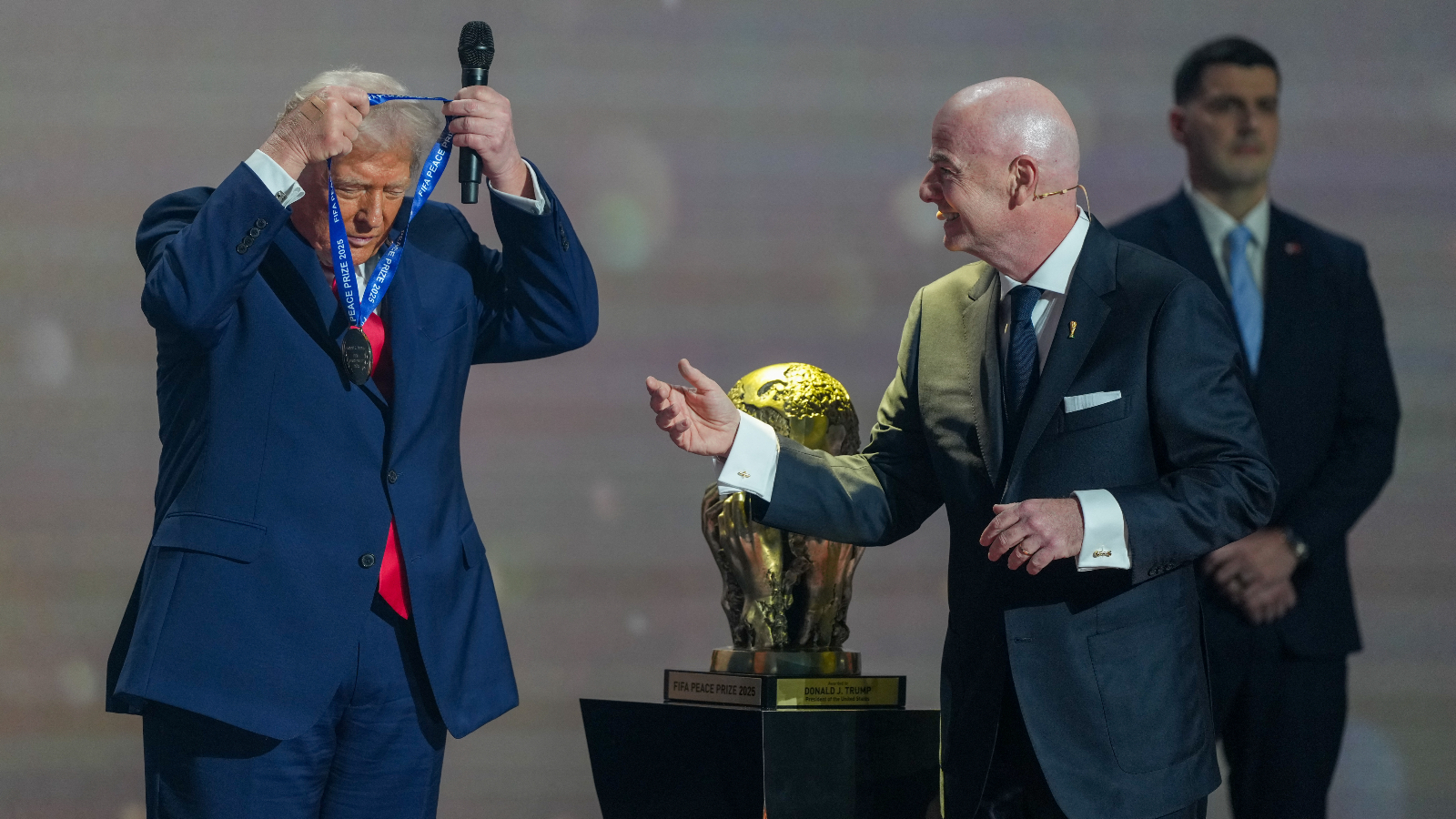
And guess what? Less than four months later, Trump launched a military campaign against Iran that has escalated into a regional conflict, reportedly killing nearly 2,000 people and displacing many more.
FIFA has long faced accusations of inconsistency in how it responds to global conflicts.
Back in 2022, the organisation moved swiftly to ban Russia from international football after the invasion of Ukraine. Yet it has resisted calls to sanction Israel despite the ongoing war in Gaza and criticism surrounding Israeli football clubs linked to settlements in the occupied West Bank.
Five years later, in 2017, Infantino famously said that if supporters from qualified nations could not enter the host country, “there is no World Cup.” And during the 2018 bidding process, Trump himself assured FIFA that all athletes, officials and fans would be able to enter the United States “without discrimination.”
Fast forward to today.
Russia was banned after invading Ukraine. Yet now the host nation itself is directly involved in a war with a qualified team — and suddenly the conversation has shifted to “safety concerns.”
How convenient.
FIFA’s statutes proudly proclaim a commitment to neutrality and international law. Yet the organisation has spent the past few years cultivating an increasingly cozy relationship with Trump — going as far as handing him a “Peace Prize.”
For now, Iran’s participation in the 2026 World Cup remains uncertain.
But if tensions continue to escalate, the real question may no longer be whether Iran attends.
It might be whether football can/will continue to keep pretending that politics and the sport exist in separate worlds.
March 13, 2026, 5:28 PM IST
Read More
Source link
[ad_3]

