
New Delhi:
The Middle East war, in its sixth week, has left the entire region in a turmoil. And, effects are both short and long-term such as inflation, energy crisis, sharp fall in investors’ confidence, etc.
In an effort to combat short-term crises, most Arab states have put measures in place. These range from closing shops and cafes early to avoiding air conditioners in buildings, dimming street lights and hiking fuel prices. But, how vulnerable are the Arab states and why?
Most Arab states trail on various social and economic parameters and a month of Iran war has made the region more vulnerable.
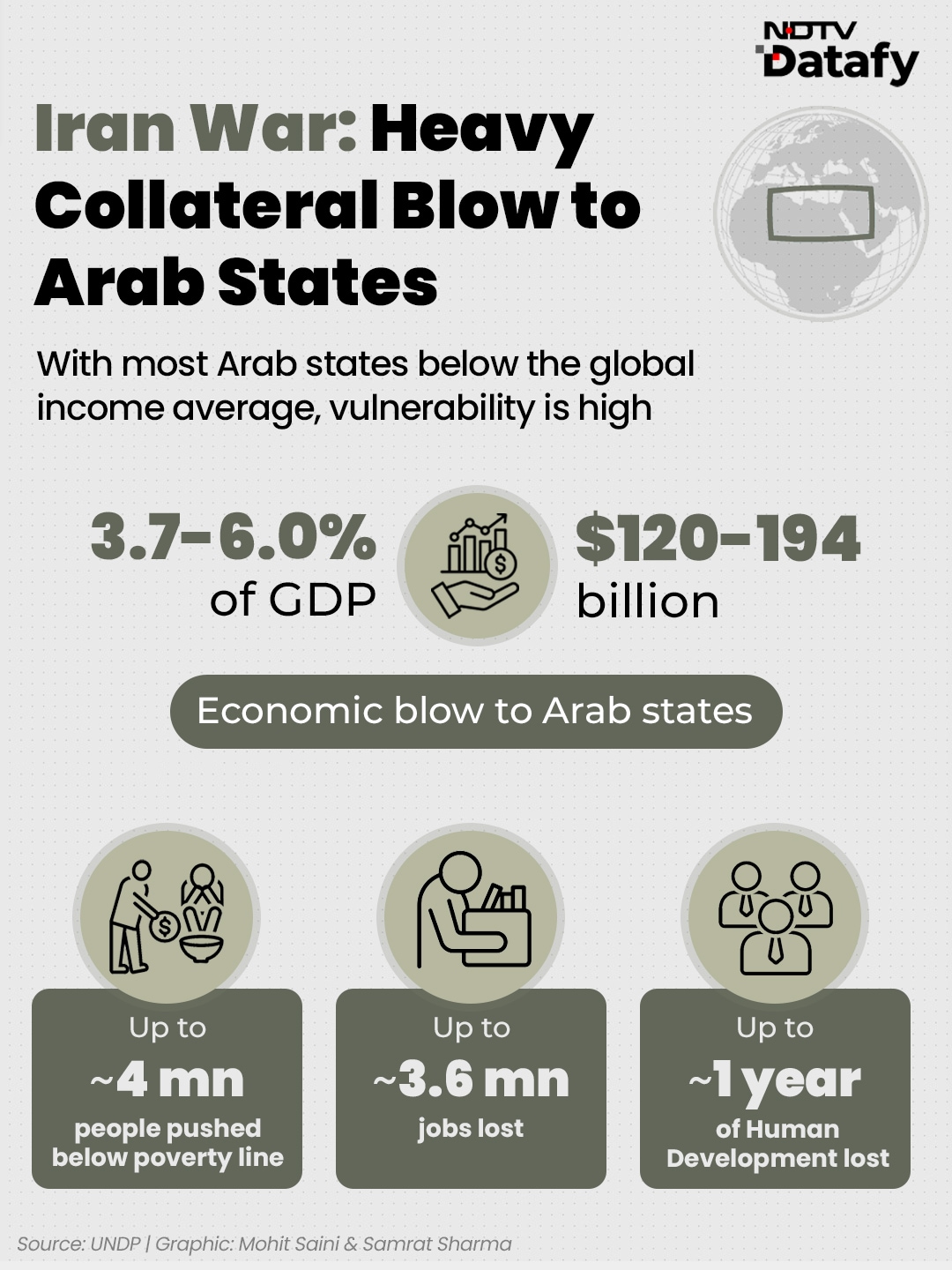
“At the regional level, GDP is estimated to decline by approximately 3.7 to 6.0 percent, equivalent to a contraction of roughly $120 billion to $194 billion, with investment contracting more sharply, reflecting heightened uncertainty and reduced capital formation,” UNDP said in a report. Trade flows also deteriorate significantly, with exports and imports declining across scenarios, it added.
Notably, Arab states referred here include Gulf Cooperation Council (GCC), including Bahrain, Kuwait, Oman, Qatar, Saudi Arabia, and the United Arab Emirates; the Levant, including Iraq, Jordan, Lebanon, Palestine and Syria; North Africa, including Algeria, Egypt, Libya, Morocco and Tunisia; and Least developed Arab countries, including Sudan and Yemen.
The concern is not only economical but also social. It is estimated that the war may have pushed up to four million people below poverty line, snatched jobs from up to 3.64 million people, and eroded up to one year of human development progress.
What makes the Arab states more vulnerable is their history with conflicts. Countries such as Palestine, Lebanon, Yemen, Sudan and Syria have been battling with regular conflicts over years and they operate on a shoestring budget and low living standard.
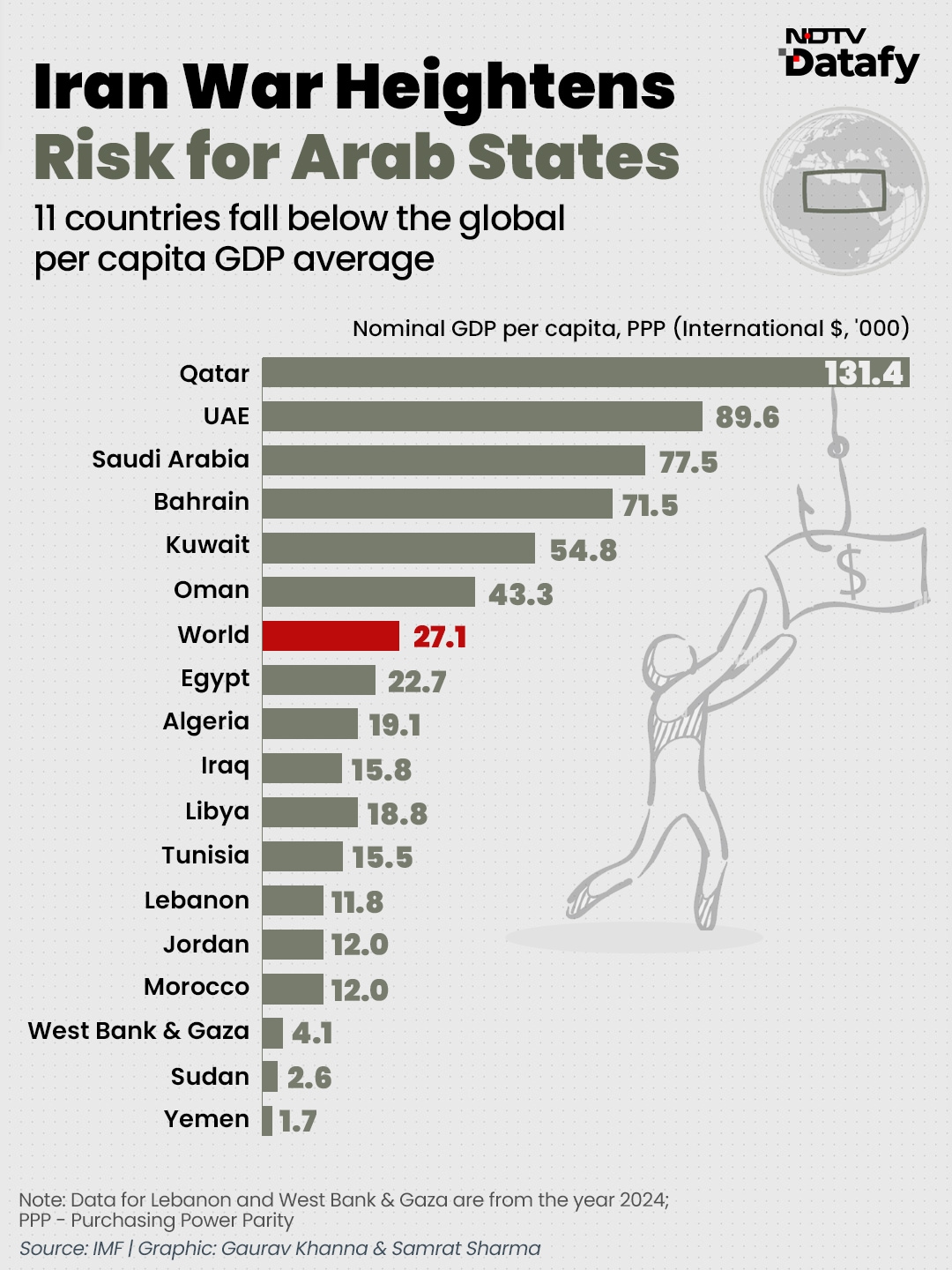
11 Arab states – Egypt, Algeria, Iraq, Libya, Tunisia, Lebanon, Jordan, Morocco, Palestine, Sudan and Yemen – have per capita GDP lower than the global average. Against the global per capita GDP of International $27.1k on the basis of purchasing power parity, Yemen has a per capita GDP of only $1.66k, Sudan $2.63k, West Bank & Gaza $4.12k and Lebanon $11.82k, according to the IMF estimates for 2026.
Meanwhile, Egypt is one of the most economically exposed countries to the war’s spillover. The reason is the high energy prices and it being a net energy importer. Inflation has already kicked in and weak currency is amplifying the shock. Egypt also has thin economic buffers compared to gulf states.
Source link
[ad_3]

