
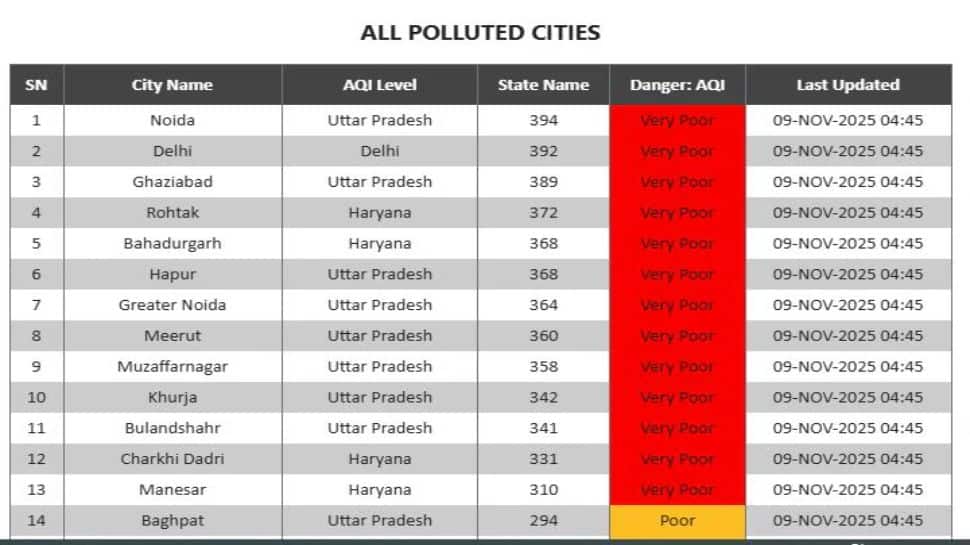
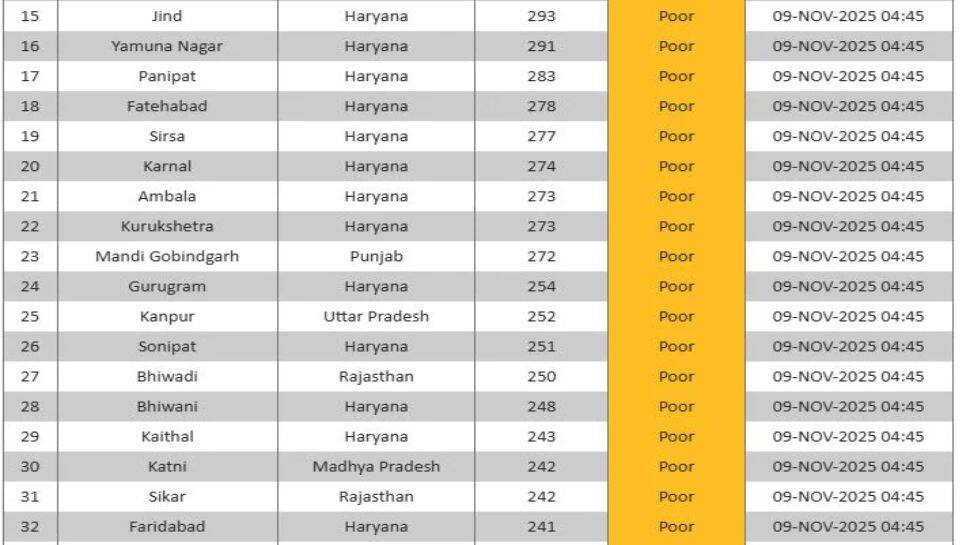
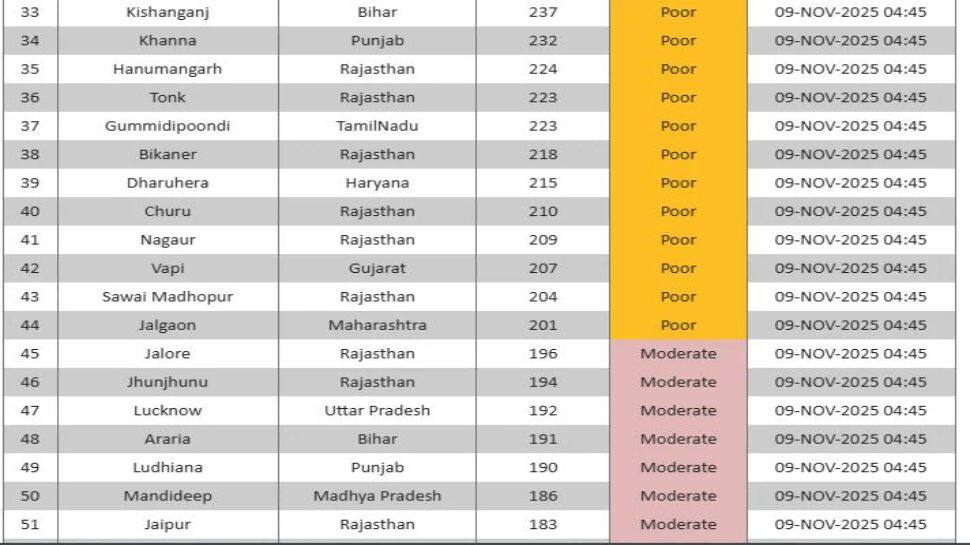
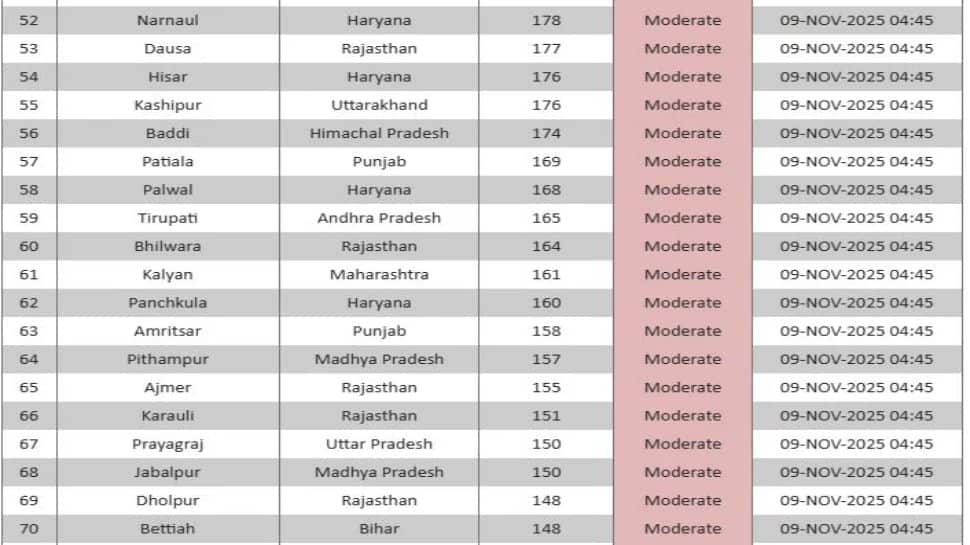
Delhi NCR Air Pollution: Delhi and the National Capital Region (NCR) are grappling with a severe pollution crisis. Noida, Delhi and Ghaziabad rank among the most polluted cities in India, with Noida at the top, Delhi second and Ghaziabad third. Rohtak and Bahadurgarh in Haryana follow, while Gurugram records poor air but ranks 24th. The ongoing cold and forecasted weather patterns show no immediate relief from the rising pollution levels. Authorities are closely monitoring the situation.
On Sunday, a dense layer of smog covered NCR, pushing the Air Quality Index (AQI) to the “very poor” category in several areas. Some locations reached the “severe” range. Wazirpur and Bawana recorded AQI at 424, Vivek Vihar at 415, while Rohini topped 435.
Other heavily affected areas include Nehru Nagar (426), Bawana (426), R.K. Puram (422) and ITO (420).
Average AQI readings stood at 391 in Delhi, 391 in Noida, 366 in Greater Noida, 387 in Ghaziabad and 252 in Gurugram.
CAQM Reviews Air Quality
The Commission for Air Quality Management (CAQM) held a review meeting on Sunday evening, studying meteorological forecasts and recent data from the Indian Meteorological Department (IMD) and the Indian Institute of Tropical Meteorology (IITM). After the session, the commission stated that while minor improvements in Delhi’s air quality were visible, AQI levels are likely to remain “very poor” in the coming days.
Graded Response Action Plan (GRAP) – 3 measures will not at present be implemented, although restrictions under phases 1 and 2 are under review.
What Is GRAP 3?
GRAP 3 imposes strict limits across Delhi, Noida, Ghaziabad, Gurugram and the wider NCR. Construction activities are halted, brick kilns and high-pollution industries are restricted, older diesel vehicles may be banned and schools up to grade 5 could switch to online learning. Work-from-home policies can also be enforced for employees.
The Delhi Pollution Control Committee said that coordinated efforts by government departments are showing results. AQI readings in most areas have improved compared to the same period last year. The city has so far avoided the extreme levels that triggered GRAP 3 in November 2023.
CAQM Warns On Stubble Burning
The commission urged immediate action to control stubble burning in Punjab. During the ongoing paddy harvest, Haryana has shown a noticeable reduction in such incidents. During a regional visit to Bathinda, CAQM Chair Rajesh Verma expressed serious concern over emissions violations at the Lahra Mohabbat Thermal Plant. He warned that the plant could be ordered to shut down if corrective measures are not taken. Isolated stubble burning incidents were also reported in the region.
Work From Home, Public Advisory
Delhi Chief Minister Rekha Gupta appealed to citizens to carpool and encouraged private organisations to allow employees to work from home.
She has also adjusted government office timings from November 15, 2025, to February 15, 2026. Government offices will operate from 10:00 AM to 6:30 PM, while MCD offices will run from 8:30 AM to 5:00 PM.
These measures aim to reduce vehicular emissions and limit public exposure to hazardous air.
“The pollution levels are serious. Citizens must take precautions, limit outdoor activity and follow guidelines. Work from home and carpooling are necessary steps to protect health,” CM Gupta stressed.
Source link
[ad_3]

