
- Hindi News
- Business
- Crude Oil Surges 27% In A Week Of Iran Israel Conflict, 20% Of Global Oil At Risk As Hormuz Blockade Halts Ships
New Delhi30 minutes ago
- copy link
Crude oil prices are continuously increasing due to increasing tension in the Middle East and interruption in the global supply of crude oil through the Hormuz Route.
Amidst the US-Israel and Iran war, the price of crude oil has increased by about 27% in a week. Today on Saturday (March 7) also, the price of Brent crude oil has increased by about 9% to reach $ 92.69 per barrel. This is also its highest level since April 2024.
The war started on February 28, when the price of crude oil was $ 72.87 per barrel. Since then, the price of crude oil has increased by about $20 per barrel in 8 days.
Oil prices are continuously increasing due to Hormuz route being affected.
Crude oil prices are continuously increasing due to increasing tension in the Middle East and interruption in the global supply of crude oil through the Hormuz Route. 20% of global oil supply is being affected due to the movement of ships on the Hormuz Route being affected. At the same time, half of the crude oil supply to India every month i.e. 50% has been affected.
The supplies to many Asian countries including India through this route have also been affected. Global Liquefied Natural Gas (LNG) is also supplied through this route. If this route remains closed for a long time, there may be a shortage of oil and gas in the entire world.
More than 200 ships stranded, 38 Indian ships included
Due to the Hormuz route being affected, more than 200 ships from many countries of the world are stranded in the Persian Gulf, while more than 150 ships are waiting outside this route.
At the same time, about 38 ships of India are also stuck in this area. These also include crude oil tankers coming to India from Russia. Insurance and shipping companies are also now reassessing the risks, which could lead to further delays.
1. What is the impact on Global-Asian countries and India?
The effects of the Hormuz Route being affected are beginning to be seen all over the world…
- Global Market: Crude oil prices have jumped by 20%. The cost of freight transportation has increased by 30-40% due to diverted global shipping routes. The fear of rising inflation has deepened in America and Europe.
- Asian countries: Countries like China, Japan and South Korea depend on the Gulf countries for 70-90% of their energy needs. The supply stoppage has created a crisis for the manufacturing units and power plants there.
- Impact on India: India imports 85% of its crude oil needs. Due to oil becoming expensive, India’s import bill will increase, due to which the rupee may weaken. If prices remain at this level, then an increase in the prices of petrol and diesel is certain.
2. What are the options available to all countries?
After the supply chain is broken, now different countries are working on alternative routes and other options…
- Uses of Strategic Petroleum Reserve (SPR): Countries like India, America and China are preparing to extract oil from their strategic petroleum reserves. India has emergency stock of about 45 days.
- Looking for alternative routes: Ships are now being routed via the ‘Cape of Good Hope’ (down Africa). However, it takes more time and money. Saudi Arabia and UAE are trying to transport oil to the Red Sea through their pipelines so that the Hormuz Route can be bypassed.
- Contact with new suppliers: Asian countries including India are now in talks to buy more oil from Russia, America, Brazil, Guyana and African countries so that their dependence on Gulf countries can be reduced.
3. What can happen next if the situation worsens?
According to experts, if this tension is not reduced then the situation may worsen in the coming days:
- Crude oil crosses $100: If the Hormuz Route remains closed for a long time, crude oil could go up to $100 to $120 per barrel.
- Increase in inflation: Due to cost of crude, fertiliser, plastic and transportation will become expensive, which will have a direct impact on the common man’s plate. Prices of food items may increase by 10-15%.
- Hopes of interest rate cut are over: Due to rising inflation, central banks around the world (like RBI and US Federal Reserve) may postpone the decision to cut interest rates, which will make loans more expensive.
- Accelerating energy transition: After this crisis, countries will move more rapidly towards solar, wind and electric vehicles (EV) so that such oil crises can be avoided in future.
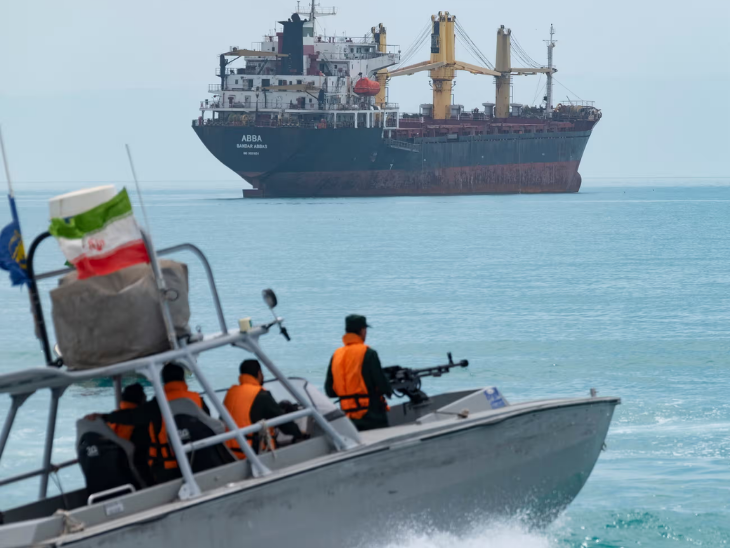
The Iranian military monitors cargo ships as they pass through the Strait of Hormuz.
Know about the Strait of Hormuz..
Why is Hormuz Strait important for India?
The Strait of Hormuz, located between Iran and Oman, is the world’s most important oil route. India imports most of its crude oil from countries like Saudi Arabia, Iraq, Kuwait and UAE, a large part of which comes through this route. India imports about 26 lakh barrels of crude oil daily through this route.
According to Kepler data, about 50% of India’s total monthly oil imports in January-February came via Hormuz. This figure was 40% in November-December 2025, which has now increased.
What is the Strait of Hormuz?
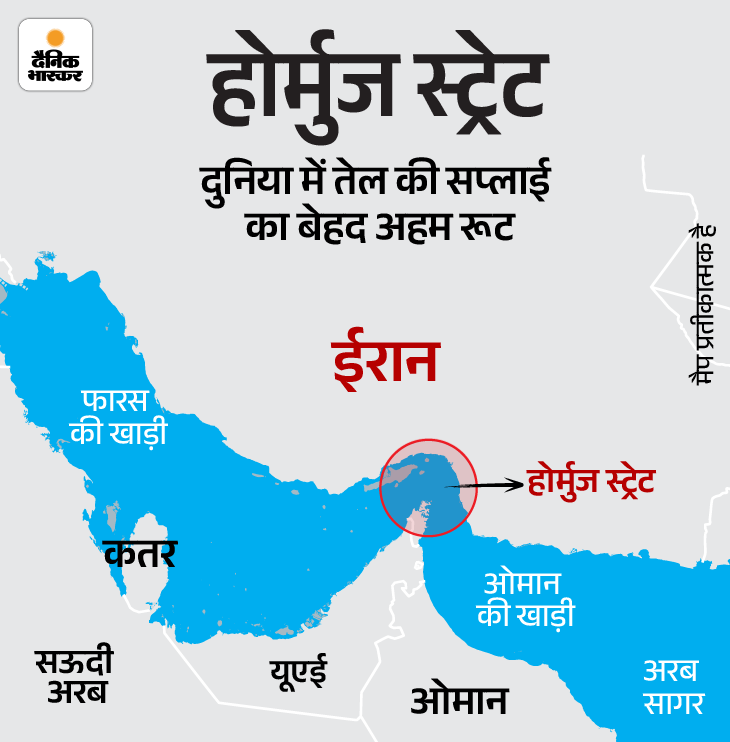
The Strait of Hormuz is a narrow waterway that connects the Persian Gulf to the Gulf of Oman and further to the Arabian Sea. Iran is adjacent to it to the north. In the south is Oman and United Arab Emirates i.e. UAE. All the oil producing countries are around it. Therefore, oil is supplied throughout the world through this waterway.
The Strait of Hormuz is about 167 km long. Both its mouths are about 50 km wide, while the narrowest part is about 33 km wide. It has a 3 km wide shipping lane for inbound and outbound maritime traffic.
Why is the Strait of Hormuz important for the world?
According to America’s Energy Information Administration i.e. EIA, about 20% of the world’s total petroleum passes through the Strait of Hormuz. Every day approximately 17.8 million to 20.8 million barrels of crude oil and fuel goes through this route. According to the International Energy Agency i.e. IEA, Iran itself exports 17 lakh barrels of petroleum through this route every day.
Commercial ships passing through this route are protected by a contingent of the US Navy. Apart from Iran, other Gulf countries like Iraq, Kuwait, Saudi Arabia and UAE also export most of their oil through this route. Most of this is exported to Asian countries. In 2022, 82% of the total oil passing through Hormuz went to Asian countries.
Read this news also…
Domestic cylinder prices increased by Rs 60: Fear of shortage of LPG due to Iran war; Government orders to increase LPG production
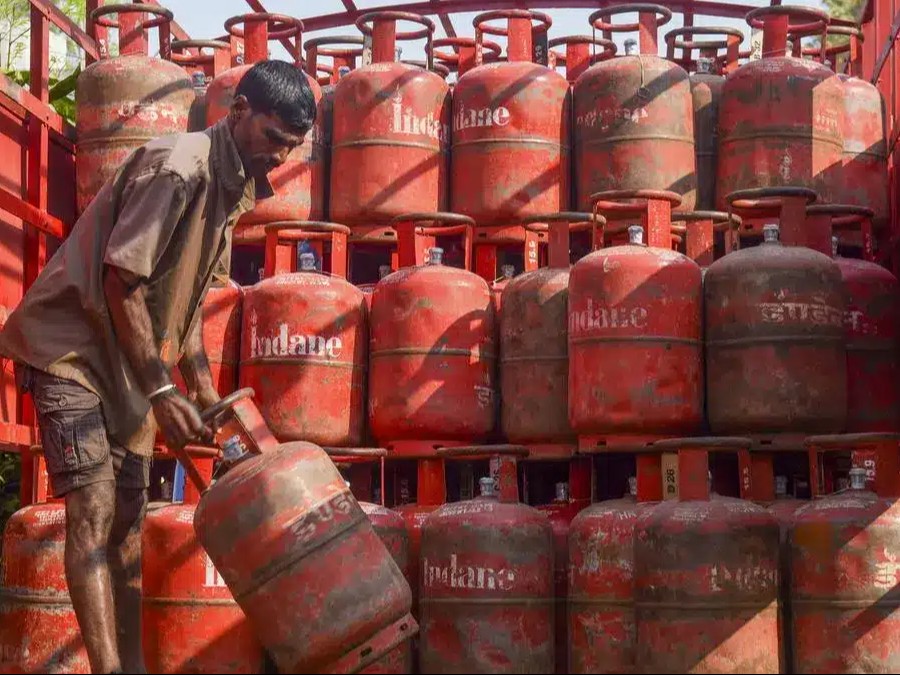
The central government has made domestic gas cylinder costlier by Rs 60. 14.2 kg LPG gas will now be available for Rs 913 in Delhi. Earlier it was Rs 853. Whereas the price of 19 kg commercial cylinder has been increased by Rs 115. Now it will be available for Rs 1883. The increased prices have come into effect from March 7.
Earlier, on April 8, 2025, the government had increased the prices of domestic cylinders by Rs 50. That means this increase has been made after about a year. Whereas on March 1, 2026, the price of commercial gas cylinder was increased by Rs 31. The government has increased the prices of gas at a time when there is a fear of gas shortage in the country due to the war between America, Israel and Iran. Read the full news…

Source link
[ad_3]

