
Four astronauts of NASA’s Artemis II mission have returned safely to Earth. His capsule i.e. Integrity landed in the Pacific Ocean near the Southern California coast. This mission lasted for 10 days. Humans have traveled near the Moon for the first time in the last 50 years. In this journey he covered a total distance of more than 11.16 lakh kilometers. This mission is part of NASA’s bigger plan, which includes landing humans on the Moon in the future and then moving towards Mars.
Why was the Artemis II mission important?
Artemis II NASA It was the first crewed test flight, involving four astronauts. They were launched on April 1 on an SLS rocket from Cape Canaveral, Florida. In the mission, after rotating in two orbits of the Earth, he came very close to the Moon and revolved around it. Passing near the far side of the Moon, they reached the farthest distance from the Earth. His maximum distance was 406771 kilometers, which was more than the old record of Apollo 13.
This mission strengthened the Artemis program. Artemis aims to have that by 2028 moon But bring down the humans. Make arrangements to stay there for a long time. This will make the Moon a stepping stone for the journey to Mars. After the last Apollo mission, humans last landed on the Moon in 1972.
Welcome home Reid, Victor, Christina, and Jeremy! 🫶
The Artemis II astronauts have splashed down at 8:07pm ET (0007 UTC April 11), bringing their historic 10-day mission around the Moon to an end. pic.twitter.com/1yjAgHEOYl
— NASA (@NASA) April 11, 2026
Now Artemis II has created history by taking humans around the Moon after half a century. For the first time, a woman, a black astronaut and a non-American citizen participated in this mission.
What happened during the splashdown?
The Orion capsule was moving at very high speed while entering the Earth’s atmosphere. At the time of re-entry it was running at a speed of approximately 39 thousand kilometers per hour. Due to the friction of the atmosphere, the temperature outside the capsule had reached 2760 degrees Celsius. This created a layer of red-hot plasma, which cut off radio contact for 6 minutes. This 13 minute journey was very stressful.
NASA engineers, learning from the uncrewed Artemis I test of 2022, changed the trajectory slightly this time, so that the heat is reduced and the heat shield remains safe. The capsule has successfully passed this test.
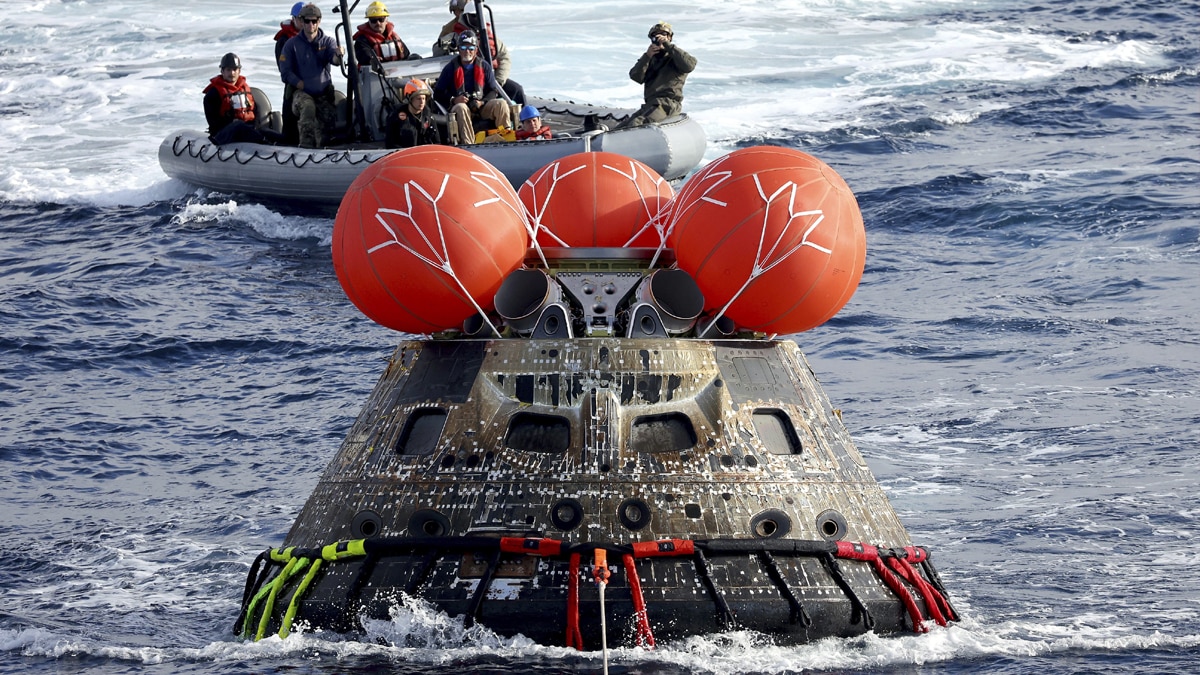
When the plasma layer was removed, two sets of parachutes opened. Due to this the speed of the capsule reduced to 24 kilometers per hour. Finally it fell gently into the Pacific Ocean. Live pictures were shown on NASA’s webcast, where the parachutes opened and the capsule was seen floating on water.
After the splashdown, NASA and US Navy teams secured the capsule. The astronauts were taken out of the capsule in about an hour. Taken by helicopter to a nearby recovery ship. His first medical checkup took place there. This entire operation was done very carefully because the capsule was floating in water.
Who were these four astronauts?
There were four members in this historic mission…
- Reed Wiseman (50 years) – Commander, American Astronaut.
- Victor Glover (49 years) – Pilot, American astronaut (the first black astronaut on a moon mission).
- Christina Koch (47 years) – Mission Specialist, American Astronaut (the first woman to go on a Moon mission).
- Jeremy Hanson (50 years) – Mission Specialist, Canadian Astronaut (first non-American to walk on the Moon).
All of them are experienced astronauts. He saw the far side of the Moon during the mission. Took beautiful pictures of the Earth and conducted many important tests. The mission revealed many achievements in science and technology, which will be helpful for future missions.
Also read: Why do humans fight? What connection are scientists making between civil wars and chimpanzees?
Artemis program’s big goal
Artemis II was not just a test flight. This is the second mission of the Artemis series. The first uncrewed Artemis I will visit the Moon in 2022. Now after the successful splashdown, NASA is preparing for Artemis III, which is to land on the Moon. The long-term goal is to build a base on the Moon, where scientific experiments can be conducted and resources can be used. All this is preparation to send humans to Mars.
This mission proved the reliability of the SLS rocket and Orion spacecraft. Companies like Boeing and Northrop Grumman also benefited from this success. During the Cold War, the Apollo mission was to get ahead of the Soviet Union, but now Artemis is to get ahead of China.
Why is this mission special?
This mission was not just a journey. This included exploration of human history, diversity and the future. For the first time, people from such backgrounds came together. The successful splashdown proved that the Orion capsule’s heat shield was working. Challenges related to re-entry are being resolved. This achievement shows how powerful science and engineering can be.
With the successful completion of Artemis II, humans are moving towards the Moon again. this is just the begining. In the coming years, settlements will be established on the Moon and the journey to Mars will come closer. This mission will inspire the youth to turn towards science, engineering and space exploration. Going so far from the Earth and returning safely is a victory of human mind and technology.
—- End —-
Source link
[ad_3]

