
New Delhi56 minutes ago
- copy link
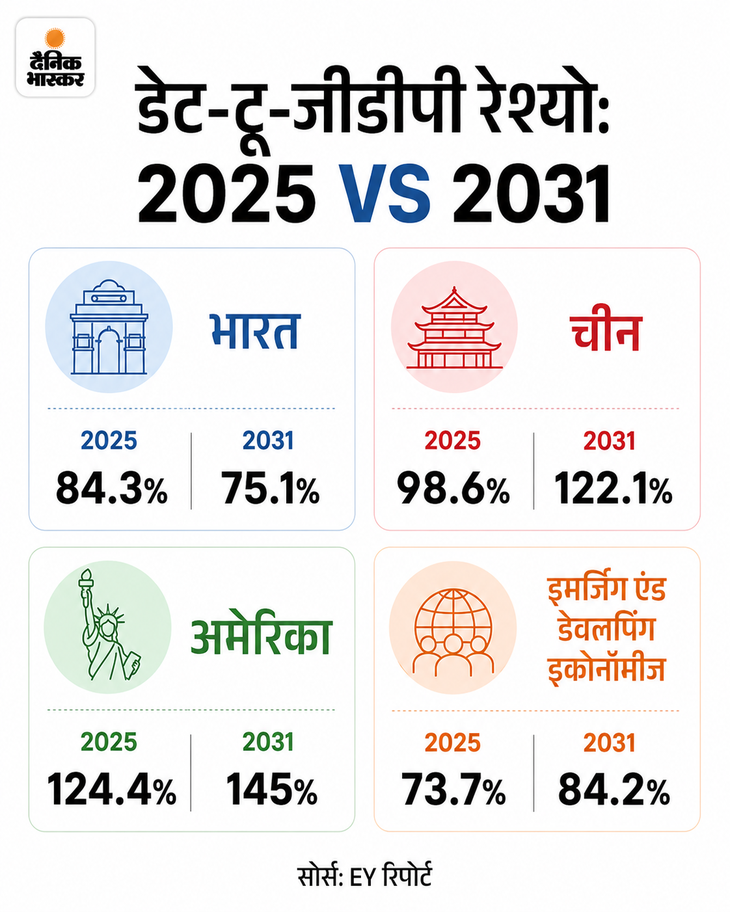
India’s general government debt-to-GDP ratio may decline from 84.3% by 2025 to 75.1% by 2031. This has been said in EY’s Economy Watch report of November 2026 quoting the estimates of the International Monetary Fund (IMF).
This figure is important at a time when government debt of many big economies of the world is increasing.
China and America’s debt expected to increase
According to the EY report, government debt as a proportion of GDP is expected to increase in most emerging economies, but India is on a different path. India’s debt-to-GDP ratio is estimated to decline by 9.2%.
The debt-to-GDP ratio of emerging markets and developing economies could increase from 73.7% in 2025 to 84.2% in 2031. The main reason for this increase is believed to be China’s debt.
Compared with other large economies, China’s debt-to-GDP ratio is expected to increase from 98.6% to 122.1%. During the same period, America’s debt-GDP ratio may increase from 124.4% to 145%.
India’s GDP growth expected to reach 7.7%
The report estimates India’s real GDP growth to be between 7.5% to 7.7% in the second quarter of FY27. Nominal GDP growth may remain around 11%, which may support government tax revenue. The Centre’s gross tax revenue grew by 6.1% in the first half of FY27, while total expenditure increased by 10.7%. Whereas the expenditure on subsidy has increased by 10.1%.
EY has predicted the possibility of increase in government expenditure on large subsidies amid persistent inflationary pressure. Due to retail inflation rising to 6.1% and wholesale inflation reaching 12.3% in October, EY has also recommended RBI to increase the policy rate in the December monetary policy meeting.
Reduction in poverty and inequality
The report also notes that India has made progress in reducing poverty and inequality while maintaining economic growth. Citing World Bank estimates, EY said that at a threshold of $3 per day (on a PPP basis), the extreme poverty rate in India would reduce from 27.1% in 2011 to an estimated 2.3% in 2024. Inequality in per capita consumption expenditure has also reduced over time.
The report said that India remains an outlier with the declining trend of general government debt as a proportion of GDP. It is expected to decline from 84.3% in 2025 to 75.1% by 2031, a decrease of 9.2% points.
However, this may also lead to increase in some big budget subsidies related to food, fertilizer and petroleum products. In the remaining part of the financial year, while export demand looks strong, domestic demand needs support.
What are the challenges ahead for India?
To keep domestic demand strong in the months ahead, EY has emphasized on maintaining government capital expenditure. At the same time, the government will also have to stick to the goals of fiscal consolidation.
Policy decisions and the balance of government expenditure will remain under watch amid rising inflation and possible subsidy pressure.
What is debt-to-GDP ratio?
The ratio of the total outstanding government debt of a country and the total GDP of the same country is called debt-to-GDP ratio. This helps in understanding how much debt the country is carrying in comparison to its economic output and what is the situation of repaying it.
Difference between real GDP and nominal GDP
Real GDP removes the effect of inflation and shows how much production actually increased in the country, whereas nominal GDP is determined at today’s market price and the effect of inflation is also included in it.

Source link
[ad_3]

