
13 minutes ago
- copy link
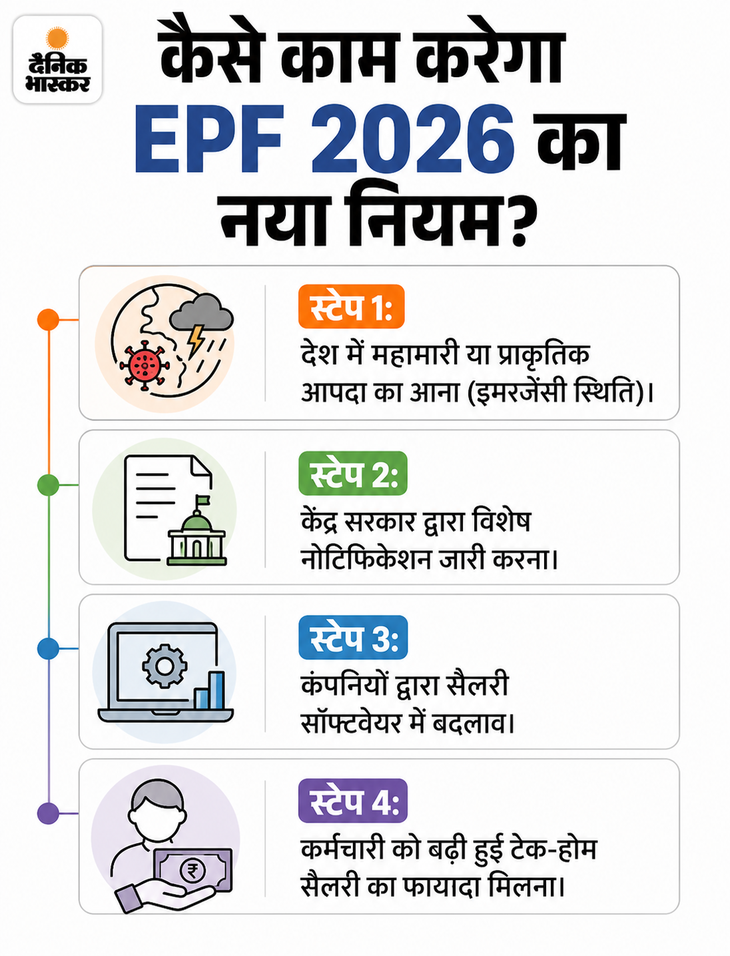
According to the new rules of EPF 2026, at the time of disaster or epidemic, the government will be able to decide to reduce or postpone the PF contribution of employees and companies.
The government has added an important emergency provision in the Employees’ Provident Fund Scheme (EPF). Under this, in the event of any epidemic or national disaster, the government can reduce or postpone the PF contribution of the employer and employee.
What impact will this new rule have on your salary, PF account and retirement fund? Understand in easy questions and answers –
Question 1: What new provision has been added to the EPF Scheme 2026?
answer: If there is any epidemic or national disaster in the country, then the Central Government will have the right to reduce or postpone the PF contribution of employees and companies for a maximum of three months at a time. This relief can be implemented across the country or for a particular state/region.
Question 2. Will the PF deductions made every month reduce once this rule is implemented?
answer: No, not at all. This is an emergency power, which allows the government to take decisions when needed. Unless the government issues a special notification during a disaster or epidemic, the normal rule of PF deduction (12% of basic salary) will remain applicable.
Question 3. Can employees choose to reduce PF contributions on their own?
answer: No. The employee or the company cannot make any changes in it on their own behalf. Under normal circumstances, it will be mandatory to pay standard 12% contribution (or 10% in notified institutions).
Question 4. Why did the government add this provision, was this not the case earlier?
answer: The government has created this clear legal framework to provide immediate financial relief to employees and companies in times of crisis. Earlier, during the Covid-19 pandemic, the PF contribution rate was reduced from 12% to 10% for May, June and July 2020, to increase cash in the hands of people. Now it has been included in the new rules as a permanent emergency tool.
Question 5. If the government reduces PF deduction, what will be the impact on in-hand salary?
answer: If the employee’s PF contribution decreases, his monthly take-home salary will increase.
- Example: Suppose your PF contribution is deducted every month by ₹ 6,000. If the government reduces it to ₹ 5,000 for three months, then you will get ₹ 1,000 additional salary every month. You will get a total savings of ₹3,000 in three months.
Question 6. Is there any disadvantage of increasing take-home salary?
answer: Yes, it will affect your retirement fund. The less money deposited in your PF account, the less compound interest you will get. The immediate benefit of take-home salary may make a dent in your retirement fund in the long run.
Question 7: What is the difference between ‘reducing’ and ‘avoiding’ contributions?
answer: There is a big difference between the two:
- Low: The rate of contribution is reduced for a fixed period, which does not have to be deposited later.
- postpone: At the time of crisis, payment is stopped, but later that outstanding amount has to be deposited in the PF account.
Question 8. Can the government change PF rates whenever it wants even on normal days?
answer: No. The rules make it clear that this power can be used only in extraordinary circumstances like epidemic, endemic or national disaster.
| Details | General condition (12%) | Emergency Situation (10%) | gap/bearing |
| Employee Monthly PF Deduction | ₹6,000 | ₹5,000 | Savings of ₹1,000 |
| Monthly in-hand salary | General | ₹1,000 more | ₹3,000 cash relief in 3 months |
| Deposit in PF account in 3 months | ₹18,000 | ₹15,000 | ₹3,000 less deposit |
| Long-term impact | you will get full interest | low deposit amount | Minor impact on retirement corpus |
Question 9: What will be the impact on employees who contribute under Voluntary PF?
answer: The rules of Voluntary Provident Fund (VPF) are different. This emergency deduction will not automatically be applicable on voluntary contributions. The emergency rule will mainly impact the statutory mandatory (12%) contribution. Additional contribution of VPF employees will be decided as per government order.
Knowledge Part: Know what is the difference between EPF and VPF
- EPF (Employees Provident Fund): This is mandatory saving under government rules. In this, it is mandatory for both the employee and the company to contribute 12% each.
- VPF (Voluntary Provident Fund): If an employee wants to save more for his retirement, then he can get PF deducted more than 12% (up to 100% of basic salary). But the company is not obliged to contribute money on this additional share.
——————————————————–
Also read this business related news…
0.4% charge on UPI payments above ₹2000: This will be charged from traders from October 15, in just 4 years the government has spent ₹8276 crore.

Payments above ₹2,000 through UPI will be charged 0.4%. The maximum limit of fees has been made up to Rs 300. This amount will depend on the individual transaction. This fee will be taken from the businessman and not from the customers.
However, on payment up to ₹ 2,000, no fee will be charged from both the customer and the businessman. Read the full news…

Source link
[ad_3]

