
Mumbaia few moments ago
- copy link
There is going to be a lot of activity in the stock market in the week starting tomorrow, June 22. Due to Muharram on 26th, there will be trading in the market only for 4 days. Technical factors ranging from US-Iran tension and buying and selling by foreign investors will decide the direction of the market.
Let us understand what can happen in the market next week…
Support and resistance
Support Zone: 23,936 | 23,870 | 23,820 | 23,466 | 23,345 | 23,320
Support means, the level where the stock or index gets support from falling down. The price does not go down easily due to increase in purchasing here. There may be a buying opportunity here.
Resistance Zone: 24,140 | 24,382 | 24,450 | 24,480 | 24,535 | 24,646
Resistance means the level where there is a hindrance in the stock or index going up. This happens due to increase in sales. There is hope for an uptrend after crossing the resistance zone.
Note: Support and resistance levels are as per the report of Wealth View Analytics.
5 factors that will decide the direction of the market…
1. Tension increased even after America-Iran peace agreement
A 60-day ceasefire was agreed upon to advance talks between America and Iran, but tensions have increased once again. Iran has once again announced the closure of the ‘Strait of Hormuz’ on Saturday. However, the US military refuted this claim.
Meanwhile, US President Donald Trump said in a social media post that if no agreement is reached with Iran in 60 days, the US may consider imposing tolls in the Strait of Hormuz in the future. This fee will be to compensate for the expenditure on security in the Middle East.
Today on Sunday, America and Iran have also reached Switzerland for peace talks. The US delegation includes Vice President JD Vance, special envoy Steve Witkoff and Trump’s son-in-law Jared Kushner. At the same time, the Iranian delegation is being led by Foreign Minister Abbas Araghach.
2. Selling in IT shares may continue
The IT sector had the biggest role in the market decline on Friday. Shares of big companies like Infosys, TCS, Tech Mahindra and HCL Tech fell up to 7%. The main reason for this decline is the revenue growth estimate of American consulting company Accenture.
Accenture has cut its revenue growth forecast for FY2026 to 3-4% from 3-5%. Its shares fell by 11%. In such a situation, the revenue of Indian IT companies is also expected to decline in the coming months. Due to this, IT shares may fall further.
Apart from this, on the technical chart, the IT index has fallen below its short and long-term moving averages, indicating further weakness. For this, the level of 27,050–27,000 is important support, while the zone of 28,250–28,300 remains resistance.
3. Return of foreign investors to the market
After a long period of selling, foreign institutional investors have once again become net buyers in the Indian market. This week, foreign investors have invested about Rs 3,400 crore in the market. Along with this, domestic institutional investors bought shares worth Rs 7,100 crore.
| category | Latest | last 7 days | last 30 days |
| DII | -1,160 | 7,108 | 90,859 |
| FII/FPI | 4,859 | 3,386 | -66,779 |
4. Some relief from rupee stability
Amid fluctuations in the currency market, the rupee closed almost flat at 94.32 against the US dollar on Friday. According to Dhawal Shah, MD of D-Risk Forex Consultancy, the rupee has received support due to the steps taken by the Reserve Bank and reduction in tension in the Middle East.
5. Experts’ opinion and technical setup
According to Sudeep Shah of SBI Securities, the broad trend of Nifty is still positive as it is trading above its 20-day and 50-day exponential moving averages (EMA).
If the market falls, the zone of 23,850-23,800 will act as a strong support. If Nifty slips below 23,800, it can go to 23,500 level. At the same time, on the upside, the level of 24,150-24,200 is the first resistance, crossing which Nifty can reach 24,500.
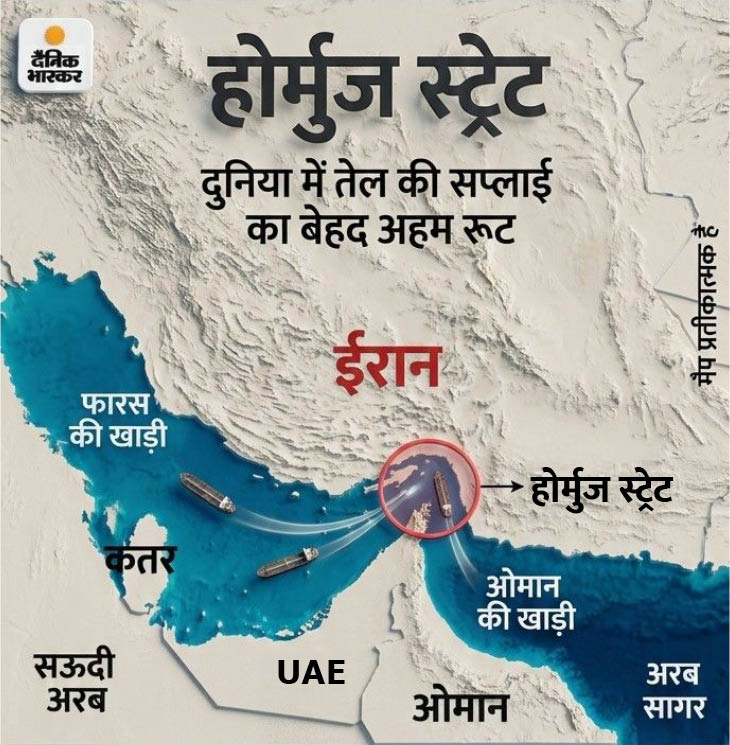
Knowledge Part: What is ‘Strait of Hormuz’?
It is a narrow and extremely important waterway located between the Persian Gulf and the Gulf of Oman. About 20% of the world’s crude oil passes through this route. Gulf countries like Saudi Arabia, Iraq, UAE and Kuwait depend on this route for their oil exports.

Source link
[ad_3]

