
- Hindi News
- Business
- Reliance Top Loser: Market Cap Down ₹46,078 Cr; HDFC Bank, Airtel Also Dip
Mumbai27 minutes ago
- copy link
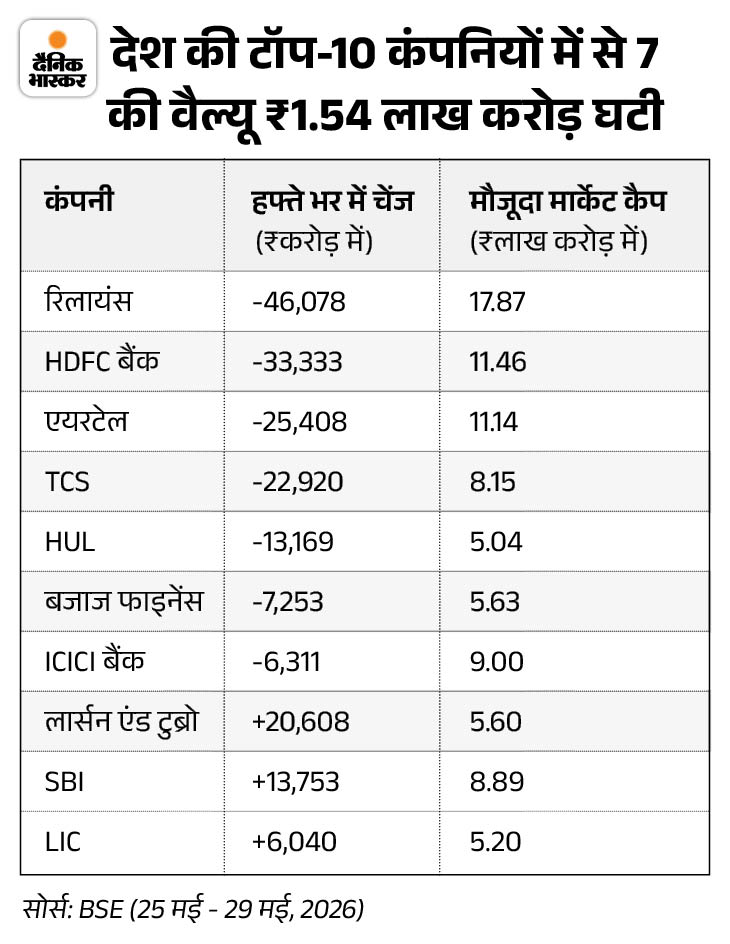
The value of 7 of the country’s 10 largest companies in terms of market cap declined by Rs 1.54 lakh crore in last week’s trading. During this period, the market value of Reliance Industries has decreased the most.
Reliance’s market value has declined by ₹46,078 crore to ₹17.87 lakh crore. Whereas the market value of HDFC Bank has declined by ₹33,333 crore to ₹11.46 lakh crore.
Apart from this, the market value of Airtel, TCS, Hindustan Unilever, Bajaj Finance and ICICI Bank has also decreased. Whereas the market value of Larsen & Toubro, SBI and LIC has increased last week.
Sensex had fallen 639 points last week
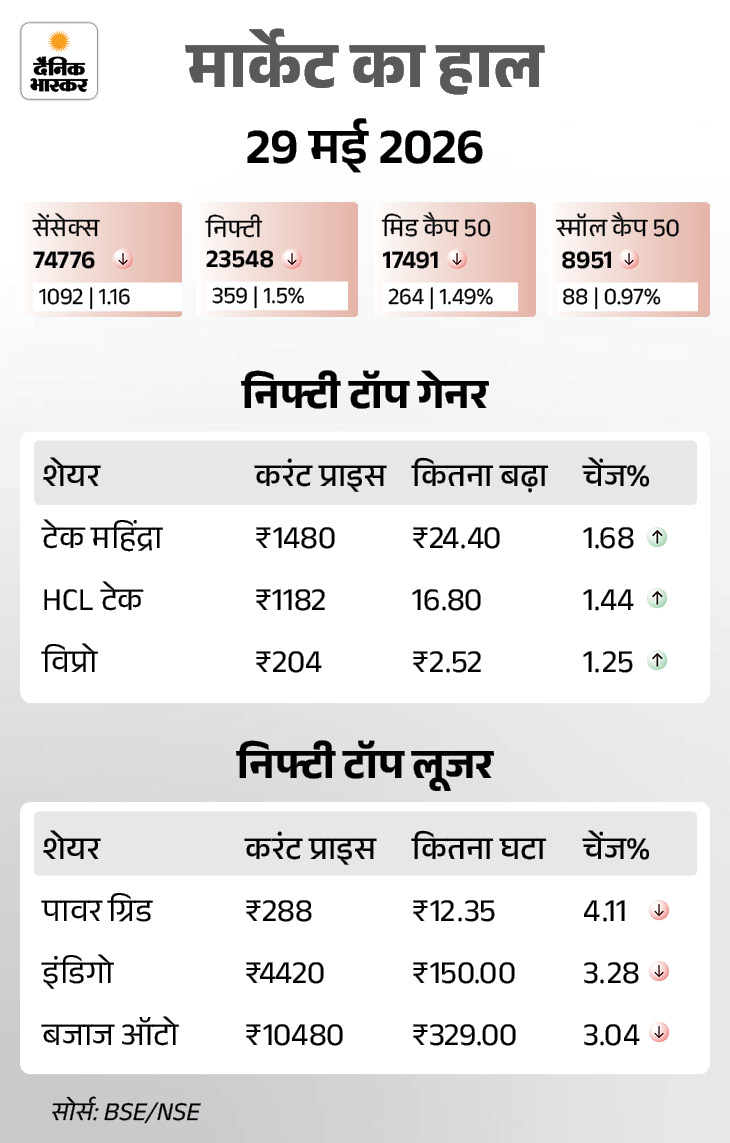
Last week, Sensex had fallen 639 (0.84%) points and Nifty had fallen 171 (0.72%) points. Whereas on the last trading day of last week i.e. Friday, May 29, the Sensex fell by 1092 points and closed at 74,775. Nifty also fell 359 points and closed at the level of 23,547.
What is market capitalization?
Market cap is the value of the total outstanding shares of any company, i.e. all those shares which are currently held by its shareholders. It is calculated by multiplying the total number of issued shares of the company by their price.
Understand this with an example…
Suppose… people have bought 1 crore shares of company ‘A’ in the market. If the price of a share is Rs 20, then the market value of the company will be Rs 1 crore x 20 i.e. Rs 20 crore.
The market value of companies increases or decreases due to increase or decrease in share prices. There are many other reasons for this…
| what does it mean to grow | what does decrease mean |
| increase in share price | decline in share price |
| strong financial performance | bad results |
| positive news or event | Negative news or event |
| positive market sentiment | Economy or market decline |
| Issuing shares at high price | Share buyback or delisting |
What effect do market cap fluctuations have on the company and investors?
Impact on the company: A large market cap helps the company to raise funds from the market, take loans or acquire other companies. At the same time, small or low market cap reduces the ability of the company to take financial decisions.
Impact on investors: Investors directly benefit from increasing market cap. Because the price of their shares increases. At the same time, the fall may cause losses, due to which investors may decide to sell shares.
Example: If TCS’s market cap increases by ₹12.43 lakh crore, investors’ wealth will increase, and the company may get more capital for future investments. But if the market cap falls, it may incur losses.

Source link
[ad_3]

