
- Hindi News
- National
- SC On Religious Practices: Hundreds Of Cases, Societal Impact | Sabarimala
New Delhi51 minutes ago
- copy link
The Supreme Court on Thursday said that if people start challenging religious practices and matters of religion in the constitutional court, it could affect religion and civilization. The court said that this will lead to hundreds of petitions and questions will be raised on every custom.
This comment was made by the Constitution Bench of nine judges, which is hearing cases related to the scope of religious freedom in different religions and discrimination against women. This also includes the case related to Sabarimala temple in Kerala and the case of Dawoodi Bohra community.
The Supreme Court on Wednesday raised questions on the validity of the 40-year-old Public Interest Litigation (PIL).
7 questions which are being debated…
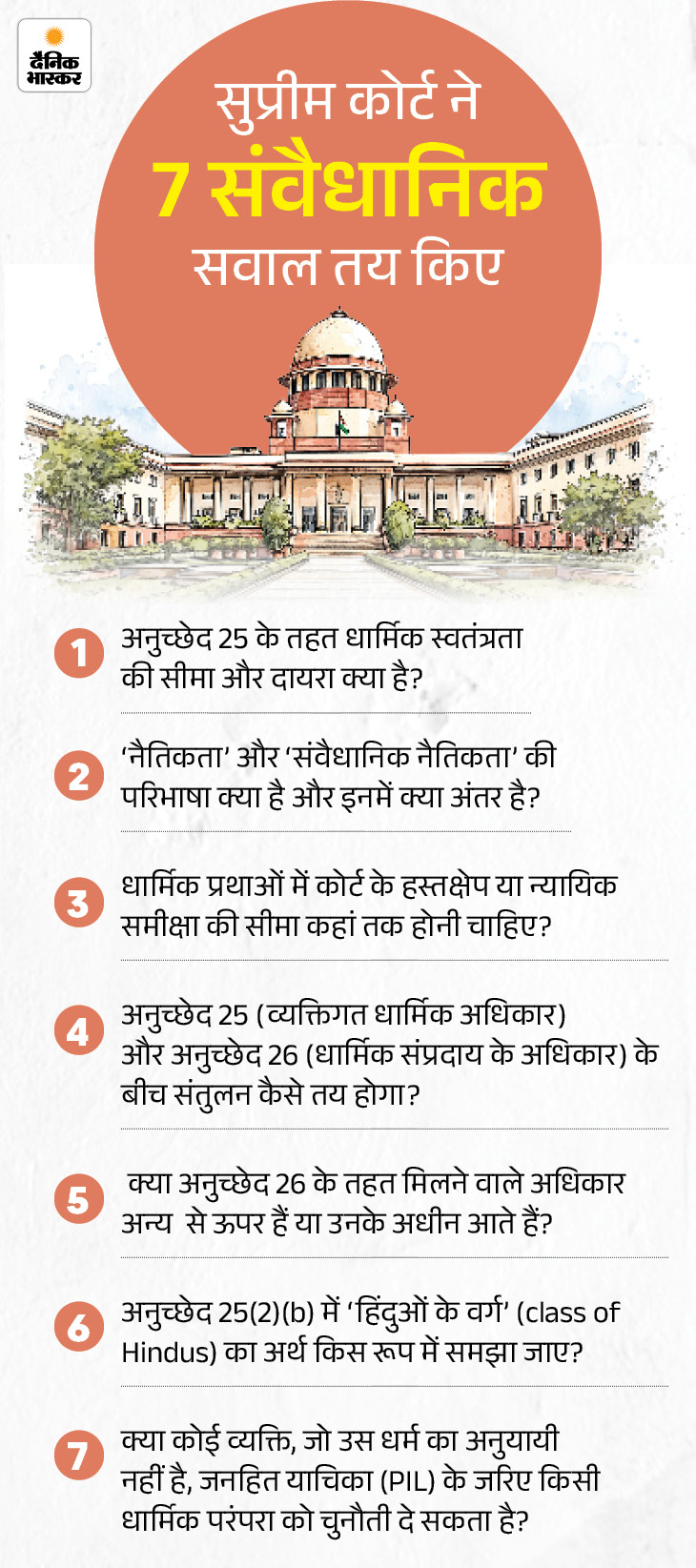
Justice Nagarathna said that if every person questions religious practices, then Indian society will be affected, because here religion is deeply connected to the society. He said, questions will be raised on every right – cases ranging from opening or closing of temples will come to the court.
Justice MM Sundresh said that if such controversies are allowed to continue, everyone will question everything. He said that this can break religions and will also affect the constitutional courts.
The matter related to Dawoodi Bohra community
This case is related to Dawoodi Bohra community. The community’s central board filed a public interest litigation in 1986, challenging the 1962 decision. In that decision the Bombay Prevention of Miscommunication Act, 1949 was repealed. Under this law it was illegal to expel a member from the community.
The 1962 decision held that excluding a member from the community on religious grounds is part of the management of the religious affairs of the community. Therefore, the 1949 law violates the rights granted under Article 26(B) of the Constitution.
Where and how to raise questions on religious practices
Senior advocate Raju Ramachandran, appearing for the reformist Dawoodi Bohra group, argued in the court that if a practice is linked to social or personal reasons, it should not get religious protection under Articles 25 and 26 of the Constitution.
He said that if any practice has a negative impact on fundamental rights, it can be limited.
On this, Justice Nagarathna said that it is necessary to decide where and how questions on religious practices should be raised – should it be within the community or should the state or the court intervene. He said that India is identified by its diversity and civilization, and religion is a permanent element in it. It would not be right to break it.
Hearing on Sabarimala case started from April 7
The hearing on the Sabarimala temple case started from April 7. During this, the central government presented arguments against the entry of women. The government had said that entry of men is also banned in many goddess temples of the country, hence religious traditions should be respected.
Read what happened in the last 9 hearings…
April 7: Centre’s argument – the decision of women’s entry into the temple is wrong
April 8- How is someone who is not a devotee challenging the religious tradition?
9 April- Supreme Court said- Stopping entry into temples will divide the society.
15 April- Sabarimala management said- Ayyappa temple is not a restaurant, celibate deity is here.
21 April- Supreme Court asked – How do gods become impure by touching?
22 April- Supreme Court said- Hindus should remain united, not divided into sects.
23 April- There is no ban on women coming to the mosque in Islam.
April 28- Roads cannot be blocked in the name of religious practices.
April 29 – Supreme Court said – will not be a part of the destruction of religion
May 5- Lawyers filed petition in Sabarimala case; The judge said- work for your people
May 6- Sabarimala case, Supreme Court said, stand cannot be changed again and again.
——————————————————————-
Also read this news:
Sabarimala case, Supreme Court said that stand cannot be changed again and again: Questions raised on validity of 1986 PIL on boycott and religious rights in Bohra community
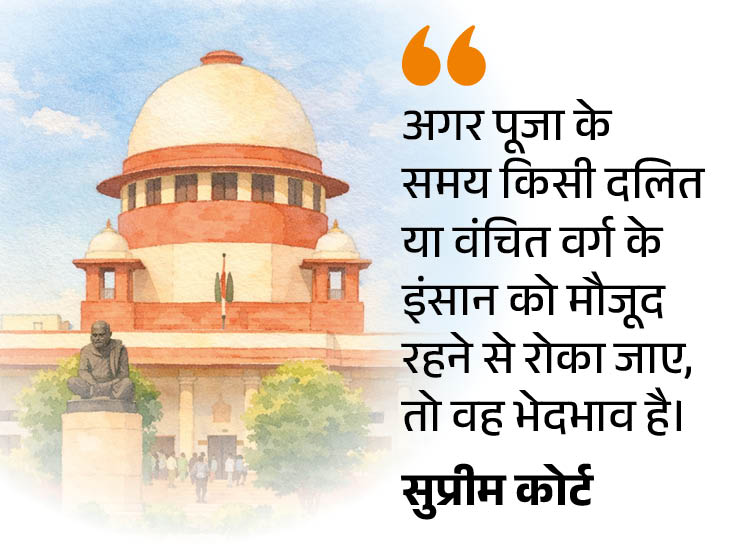
The Sabarimala case was heard in the Supreme Court on Wednesday. The court raised questions on the validity of the 40 year old Public Interest Litigation (PIL). This petition is related to the right of excommunication and its constitutional protection in the Dawoodi Bohra community. The court said that it has to live with the old decision and cannot change its stand suddenly. Read the full news…

Source link
[ad_3]

