
- Hindi News
- Business
- Inflation In Pakistan Could Rise To As High As 11%, And The Pakistani Rupee Could Reach 298 Against The US Dollar
New Delhi54 minutes ago
- copy link
Due to the ongoing tension in the Middle East and the increasing oil crisis, the pressure on Pakistan’s economy is going to increase further. If crude oil prices continue to rise in the international market, the inflation rate in Pakistan may again cross double digits and reach 11%.
At the same time, the price of Pakistani rupee can go up to 298 against the dollar. This information has been given in the Pakistan Strategy Report of Dawn and Topline Securities Limited.
Crude oil may reach $120 per barrel, inflation will increase
According to the report, in the current situation, inflation may remain between 9 to 10% on an average for the next one year. It is expected to go above 11% in the fourth quarter of fiscal year 2026.
If the price of crude oil remains at $100 per barrel, inflation will increase and for every $10 rise in oil, inflation will increase by 50 basis points.
If oil reaches $120 per barrel, annual inflation may reach 11%, which will force the State Bank of Pakistan to increase interest rates.
Pakistan’s GDP growth forecast also cut due to inflation
Pakistan’s economic growth is likely to slow down due to rising inflation. The report has reduced the GDP growth estimate for FY 2027 from 4.0% to 2.5 to 3.0%.
Growth for fiscal year 2026 is likely to be 3.5 to 4.0%. This could have its worst impact on the industrial sector, where growth could fall from 4% to just 1%.
Pakistan’s CAD may cross $8 billion in fiscal year 2027
The report warns that if the government does not control imports, then Pakistan’s current account deficit i.e. CAD may cross $ 8 billion (about ₹ 67,000 crore) in the financial year 2027.
This will further increase the pressure on foreign exchange reserves. At the same time, the fiscal deficit i.e. fiscal deficit in the financial year 2026 is estimated to be 4.0 to 4.5% of GDP, which is much higher than the targets set by the International Monetary Fund (IMF).
Pakistani market becomes the worst performing market in the world
The Pakistan Stock Exchange (PSX) has been one of the worst performing bourses in the world. The main reason for this is the heavy dependence on imports for energy. Pakistan imports 85% of its energy needs.
Petroleum imports are estimated to reach $15 billion in fiscal year 2026. For this reason, a decline of 15% has been seen in the market in the first quarter of the year.
There is a possibility of decline in exports and funds coming from abroad.
A 3.5% decline in remittances (money coming from abroad) may have an impact on Pakistan’s economic future. Money coming from Gulf countries (GCC) may decline by 10%.
Besides, exports are also expected to decline by 4%. Pakistani Rupee (PKR) may also weaken against the dollar and reach the level of 298 by financial year 2027.
What is Consumer Price Index i.e. inflation rate?
Consumer Price Index (CPI) is a measure by which we measure changes in the average prices of goods and services purchased by the general public. When this rate is said to be 11%, it means that the average spending has increased by 11% compared to last year.
Read this news also…
Diesel became costlier by 55% and petrol by 43% in Pakistan: Diesel became costlier by Rs 184 to Rs 520, petrol increased by Rs 137 to Rs 458/litre; impact of iran war
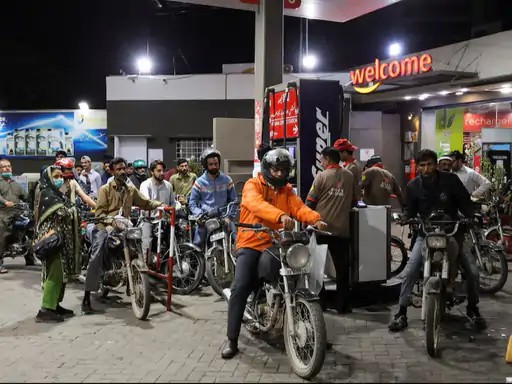
Diesel and petrol have become the most expensive in Pakistan. One liter petrol has crossed Rs 458 and diesel Rs 520 (Pakistani Rupee). The government has increased the price of petrol by 43% and high-speed diesel (HSD) by 55%. Read the full news…

Source link
[ad_3]

