
New Delhi:
NASA’s historic Moon mission Artemis II, the second such crewed flight in over five decades, soon ran into a glitch in a system that has been installed for the first time in a mission going into deep space – its toilet.
The glitch in the creature comfort came hours after the mission lifted off Florida’s Cape Canaveral early on Thursday, carrying four astronauts in a crewed flight to the Moon on the Orion spacecraft. Artemis II mission specialist Christina Koch reported to mission control in Houston about a blinking fault light connected to a fan used in urine collection. The toilet can still be used for solid waste.
NASA’s associate administrator Amit Kshatriya said the “controller issue” would take some hours to troubleshoot, with mission control guiding Koch through a series of steps in an attempt to fix the issue.
“Happy to report that toilet is go for use,” Mission Control’s Capcom Amy Dill radioed Koch later. “We do recommend letting the system get to operating speed before donating fluid, and then letting it run a little bit after donation.” “We are cheers all around, and we will do that,” Koch replied.
Liftoff.
The Artemis II mission launched from @NASAKennedy at 6:35pm ET (2235 UTC), propelling four astronauts on a journey around the Moon.
Artemis II will pave the way for future Moon landings, as well as the next giant leap — astronauts on Mars. pic.twitter.com/ENQA4RTqAc
— NASA (@NASA) April 1, 2026
How Does The Toilet On Orion Work?
The Universal Waste Management System aboard the Orion is a door on the floor, situated next to the hatch from where astronauts enter the spacecraft. It is about as big as a toilet on a passenger jet, but allows astronauts some privacy. But using it would be an arduous task. Koch said it is so loud inside the toilet that one will have to wear hearing protection.
Handrails and foot tethers will hold the bathroom user in place. A funnel attached to a hose will process the urine, while a seat is meant for solid waste. Automatic air flow will both reduce odour and pull the waste away from the body into storage containers.
As Artemis II is a short mission – kust 10 days long – the crew will vent urine out of the spacecraft.
Reid Wiseman, Victor Glover, Christina Koch and Jeremy Hansen ahead of the Artemis II launch.
Photo Credit: Reuters
First Time A Spacecraft Has A Toilet
A toilet has been installed on a mission into deep space for the first time, with astronauts aboard the Apollo missions in the 1960s and 70s using waste collection bags during spaceflight. The bags were then left on the lunar surface to reduce contamination risk during the journey back to Earth, per New York Times.
On longer missions, like on the International Space Station, urine is recycled into drinkable water. Fecal waste is stored in containers that filter odour and gas buildup and are disposed on return to Earth.
About Artemis II Mission
Three Americans – Reid Wiseman, Victor Glover and Koch – and one Canadian Jeremy Hansen were launched into space from Florida’s Kennedy Space Center at approximately 6.35 pm local time. “We have a beautiful moonrise. We’re headed right at it,” said Wiseman, the mission commander.
The astronauts are now in orbit around the Earth, where they will remain while performing various checks to ensure the reliability and safety of a spacecraft that has never carried humans before. They successfully completed “promixity operations” demonstrations, which tested how their Orion capsule can move relative to another spacecraft and included various maneuvers that mimic what would be needed to dock with a lunar lander.
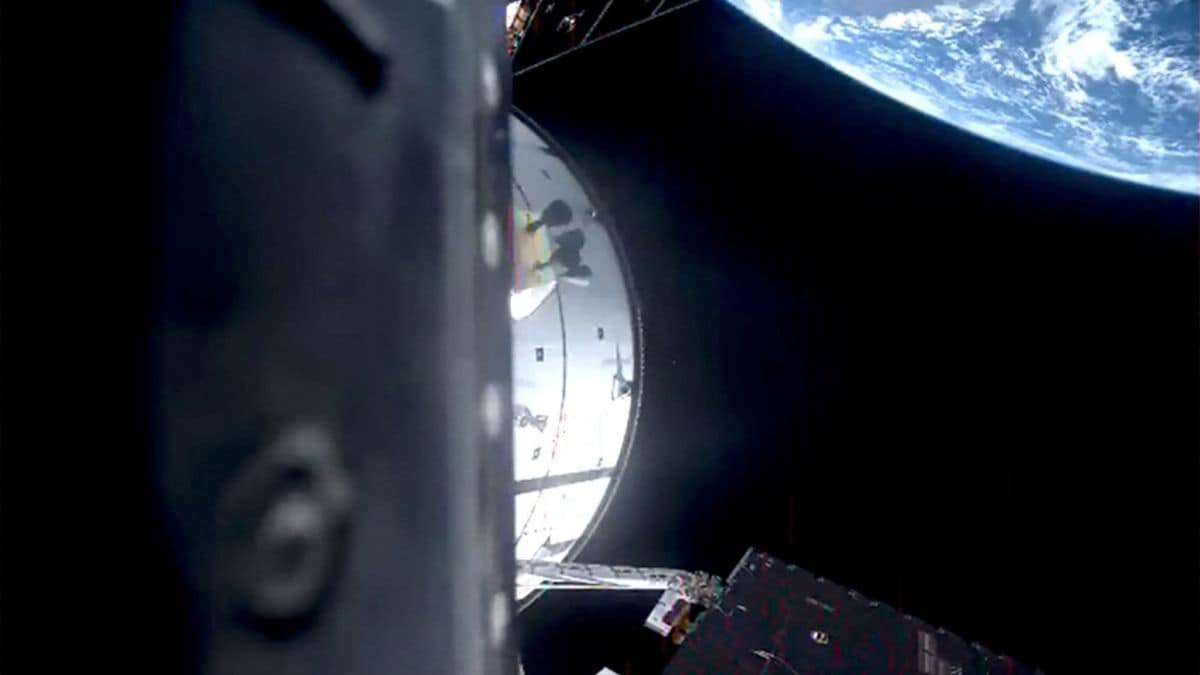
A view from the Orion spacecraft.
Photo Credit: Reuters
NASA head Jared Isaacman noted a temporary communication problem with the spacecraft that had since been resolved.
If all goes well the Artemis 2 team is expected to head out Thursday on its three-day journey towards the Moon, which it will then loop around to capture new images and make naked-eye observations. The voyage should last approximately 10 days in total, and aims to pave the way for a Moon landing in 2028.
The mission marks a series of historic accomplishments: it will send the first person of color, the first woman and the first non-American on a lunar mission. If the plan proceeds as expected, the astronauts will set a record by venturing farther from Earth than any human before. It is also the inaugural crewed flight of NASA’s new lunar rocket, dubbed the Space Launch System. SLS is designed to allow the United States to repeatedly return to the Moon, with the goal of establishing a permanent base that will offer a platform for further exploration.
Source link
[ad_3]

