
Last Updated:
The data also shows a widening gap between deaths and compensation. While all 62 deaths reported in 2021 received full compensation, this declined sharply in subsequent years




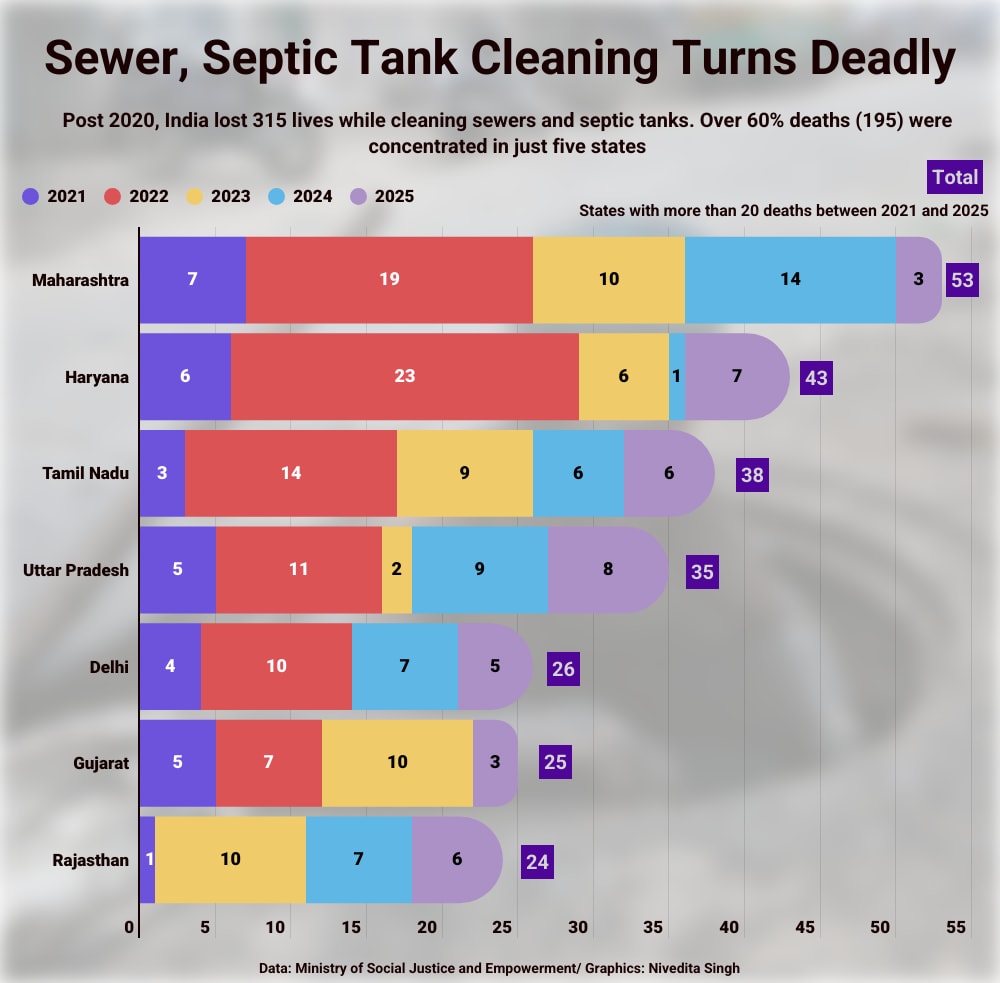
Of the total 315 deaths across India between 2021 and 2025, more than 60 per cent fatalities (195) were concentrated in just five states. (PTI)

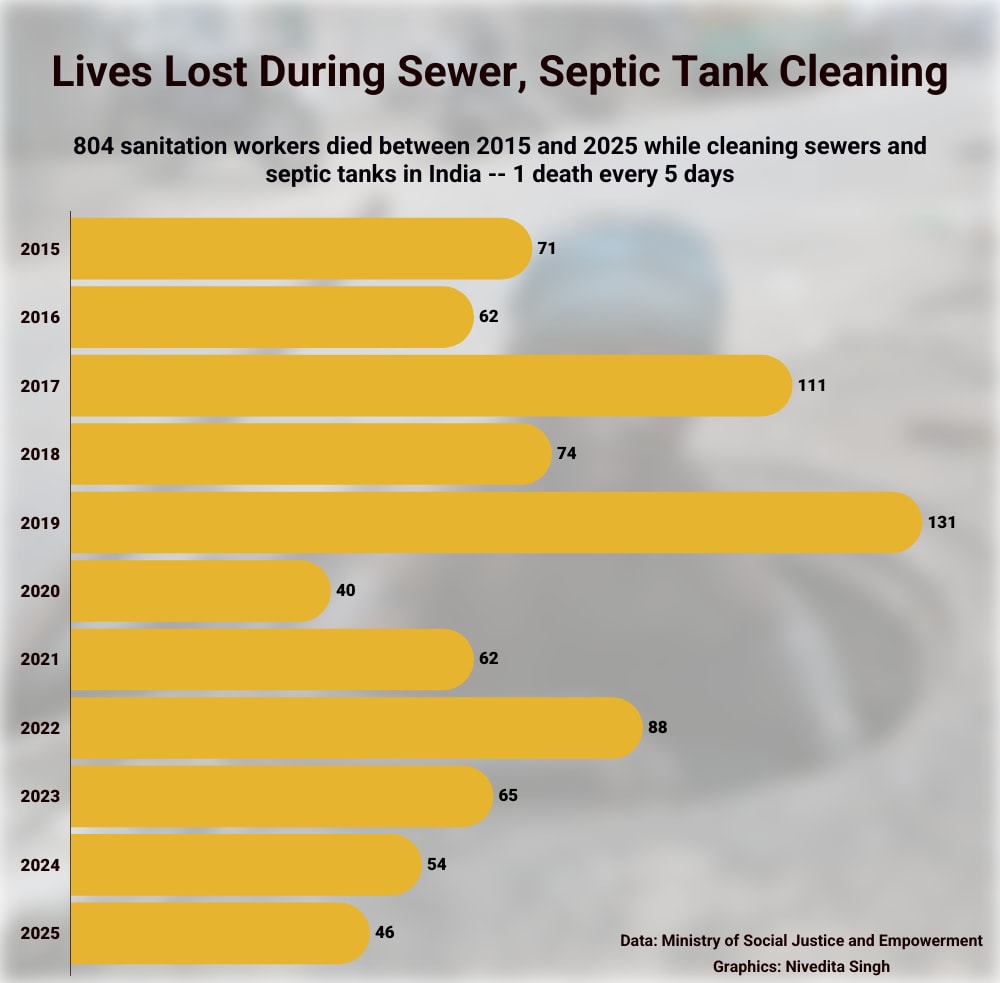
India has lost more than 804 sanitation workers due to hazardous cleaning of sewer and septic tanks between 2015 and 2025, according to official data analysed by News18. On average, 73 sanitation workers die each year due to hazardous cleaning of sewers and septic tanks. This also means about six every month and one every five days between 2015 and 2025.
The data from the Ministry of Social Justice and Empowerment shows that the highest number of deaths were reported in 2019 at 131, while the following year, 2020, saw the lowest deaths at 40.
In 2019, there were about 11 deaths a month, and one every three days due to these operations. This dropped sharply in 2020 to three deaths a month and one every nine days.
In 2025, 46 sanitation workers died while cleaning sewers and septic tanks. Though lower than previous years, 2025 still saw nearly one death every week. In 2024, 54 such deaths were reported, about one every seven days.
Annual deaths show no consistent decline over the past decade despite policy interventions, with 71 deaths recorded in 2015 and 62 in 2016.
Deaths in 2024 and 2025 are notable as in July 2024, out of 766 districts in the country, 732 districts have reported themselves as manual scavenging-free.
Last Five Years
A total of 315 sanitation workers died across India between 2021 and 2025 — more than one every week — while cleaning sewers and septic tanks.
The data from the Ministry of Social Justice and Empowerment shows that between 2021 and 2025, 2022 reported the highest number of deaths of sanitation workers at 88—about two per week.
The ministry cited the data from the National Commission for Safai Karamcharis (NCSK) for the deaths of sanitation workers due to hazardous cleaning of sewer and septic tanks. The ministry has maintained that since sanitation work is occupation-based rather than caste-based, the “caste-wise details of sewer deaths are not maintained”.
Of the total 315 deaths across India between 2021 and 2025, more than 60 per cent fatalities (195) were concentrated in just five states. Maharashtra alone accounted for 53 deaths in five years, the highest in the country. It is followed by Haryana and Tamil Nadu with 43 and 38 deaths respectively. Uttar Pradesh (35) and Delhi (26) also appear in the top five list.
Gujarat (25) and Rajasthan (24) were the other two states with more than 20 deaths between 2021 and 2025.
In a total of 11 states, the total deaths in five years were more than 10 while in the remaining states and UTs, only sporadic fatalities were reported, mostly in single digits. West Bengal (13), Karnataka (12), Punjab (12) and Madhya Pradesh (11) were the other states in the top.
The 88 deaths in 2022 were majorly driven by Haryana (23 deaths) and Maharashtra (19 deaths) reporting exceptionally high casualties that year.
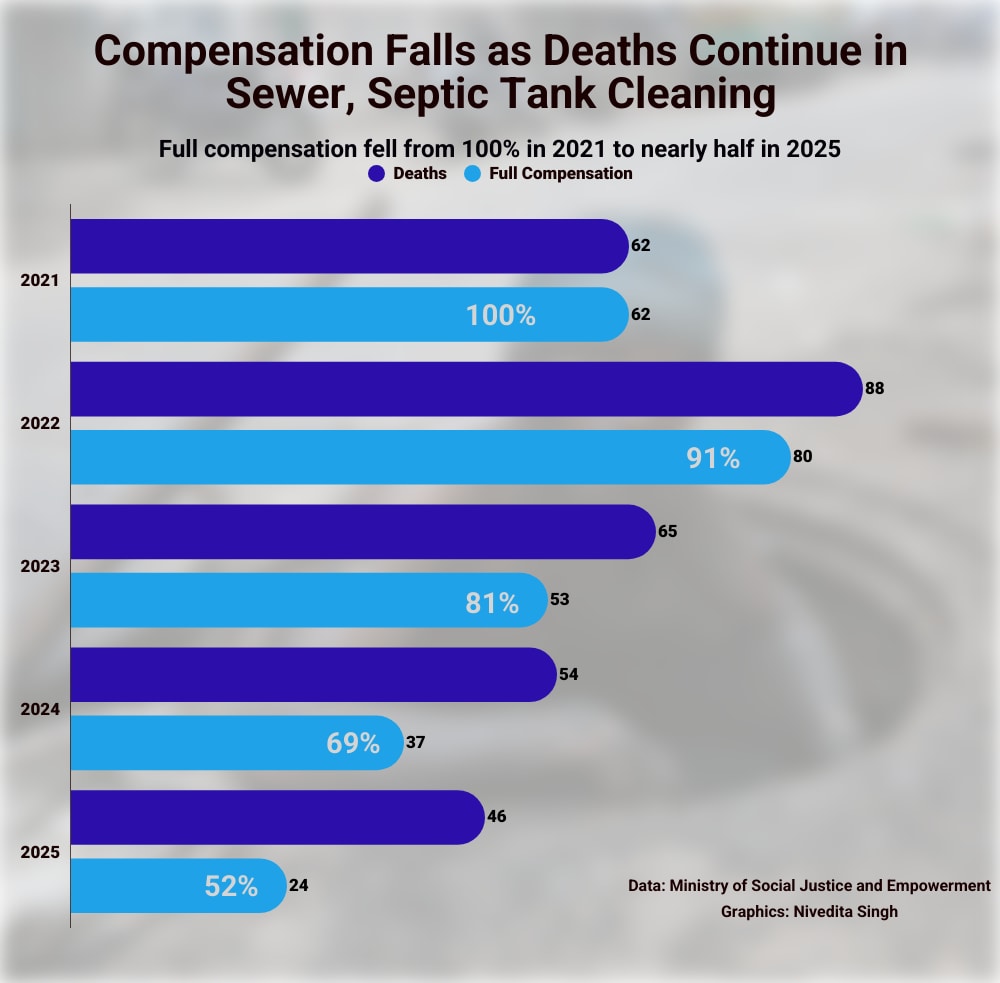
The data also shows a widening gap between deaths and compensation. While all 62 deaths reported in 2021 received full compensation, this declined sharply in subsequent years.
In 2025, only 24 of the 46 deaths were fully compensated, indicating just 52 per cent of the affected families received complete financial relief.
Manual Scavenging Banned, Yet Risks Continue on Ground
As per official records, “hazardous cleaning” refers to manual cleaning of sewers or septic tanks without mandated safety gear and precautions. A “manual scavenger” is defined as a person engaged in handling human excreta in insanitary conditions, including open drains or pits before it fully decomposes.
The Prohibition of Employment as Manual Scavengers and their Rehabilitation Act, 2013 bans such practices and mandates their complete elimination along with rehabilitation of identified workers.
Sanitation falls under state jurisdiction, with Urban Local Bodies (ULB) responsible for planning and managing services. As per the norms, it is the responsibility of state/ULBs to plan, design, execute and operate sanitation projects in the urban areas of the country.
Last week, the Social Justice and Empowerment Ministry informed the Rajya Sabha that a fresh survey of manual scavengers was conducted in all districts of the country under which no manual scavenger has been found. However, 58,098 manual scavengers have been identified during two surveys conducted in 2013 and 2018.
As per the data, the highest number of manual scavengers were registered in Uttar Pradesh (32,473), Maharashtra (6,325) and Uttarakhand (4,988) based on the earlier surveys.
The National Action for Mechanized Sanitation Ecosystem (NAMASTE) scheme to ensure safety and dignity of sewer and septic tank workers (SSWs) was launched in 2023-24. Under this, the workers are offered personal protective equipment kits, occupational safety training, safety devices to Emergency Response Sanitation Units (ERSUs) in larger Urban Local Bodies, capital subsidy for sanitation related machinery to sanitation workers.
Also, Swachh Bharat Mission-Urban (SBM-U) 2.0 was launched in October 2021 and includes a new component—Used Water Management (UWM) with one of the objectives as eradication of hazardous entry into sewers and septic tanks and sustaining elimination of manual cleaning, through mechanization of sewer and septic tank cleaning operations.
Despite legal bans and repeated emphasis on mechanisation and safety, sanitation workers continue to die while cleaning sewers and septic tanks. The death of one sanitation worker every five days on average underscores the gap between policy intent and ground reality.
March 21, 2026, 09:06 IST
Read More
Source link
[ad_3]

