
Seventeen days after Israel killed Iran’s Supreme Leader Ayatollah Ali Khamenei, the country’s power structure has been hit by another wave of high-profile assassinations. Among those killed are Ali Larijani, once considered the second most powerful man in Iran, and Gholamreza Soleimani, who headed the Basij paramilitary force.
The strikes are part of a broader campaign that has systematically removed key figures from Iran’s military and political leadership, including the head of the National Defence Council, the commander of the IRGC, and the defence minister.
On Wednesday, Israel’s Defence Minister Israel Katz confirmed another major killing, announcing that Iran’s Intelligence Minister Esmail Khatib had been “eliminated” in an overnight strike.
Read | Iran’s Intelligence Minister Esmail Khatib Killed In Strikes: Israel
While disclosing the operation, Katz warned that the campaign was far from over. “Significant surprises are expected throughout this day on all the fronts,” he said, without offering specifics.
He added, “We will continue to thwart and hunt them all down.”
Amid the turmoil, Iran formally named Mojtaba Khamenei as its third Supreme Leader on March 9. However, he has not appeared in public since the strike that reportedly killed his father, wife, and son.
His absence has only intensified uncertainty over who is truly in charge of the country.
IRGC Emerges As The Power Centre
At the heart of this uncertainty is the Islamic Revolutionary Guard Corps (IRGC), long described as a “state-within-a-state”. With its vast military, political, and economic reach and a decentralised command structure, the IRGC is uniquely positioned to absorb shocks to the leadership.
Members of Iran’s parliament dressed in IRGC uniforms, chant “Death to America” during a session in Tehran on February 1, 2026
Photo Credit: AFP
In the wake of successive “decapitation” strikes and reports of injuries to Mojtaba Khamenei, the IRGC is now exercising significant autonomous authority. In effect, it is operating like a military junta, shaping wartime strategy and overshadowing the civilian government.
Sadeq Larijani
Attention has now turned to Sadeq Larijani, brother of the late Ali Larijani and a senior figure within the system. Currently serving as Chairman of the Expediency Discernment Council, he has emerged as a potential interim leader.
According to Yigal Carmon, the president of the Middle East Media Research Institute in Israel, Sadeq Larijani may be an acceptable choice for the IRGC.
“He might be a candidate because the IRGC would want a hardliner. They need someone who will go with them who will move with them, who will collaborate with them,” Carmon told the New York Post.
“He’s not a competitor with them. He will work with them,” he added.
Mohammad Bagher Ghalibaf
Another key figure in the succession battle is Mohammad Bagher Ghalibaf, the current speaker of parliament and a long-time IRGC insider.
With a background as a former commander of the IRGC air force, Ghalibaf maintains deep ties to the military establishment. He has frequently appeared on state television leading parliament in chants of “Death to America! Death to Israel!”
The Official Interim Leadership
Formally, Iran has established a three-man leadership council to govern in the aftermath of the Supreme Leader’s death. The council includes President Masoud Pezeshkian, senior cleric Alireza Aarafi, and judiciary chief Gholam-Hossein Mohseni-Ejei.
Behind the scenes, Iran’s political establishment remains divided. According to reports, IRGC commander Ahmad Vahid pushed for Mojtaba Khamenei’s elevation as Supreme Leader, framing it as a defiant signal against the United States and Israel.
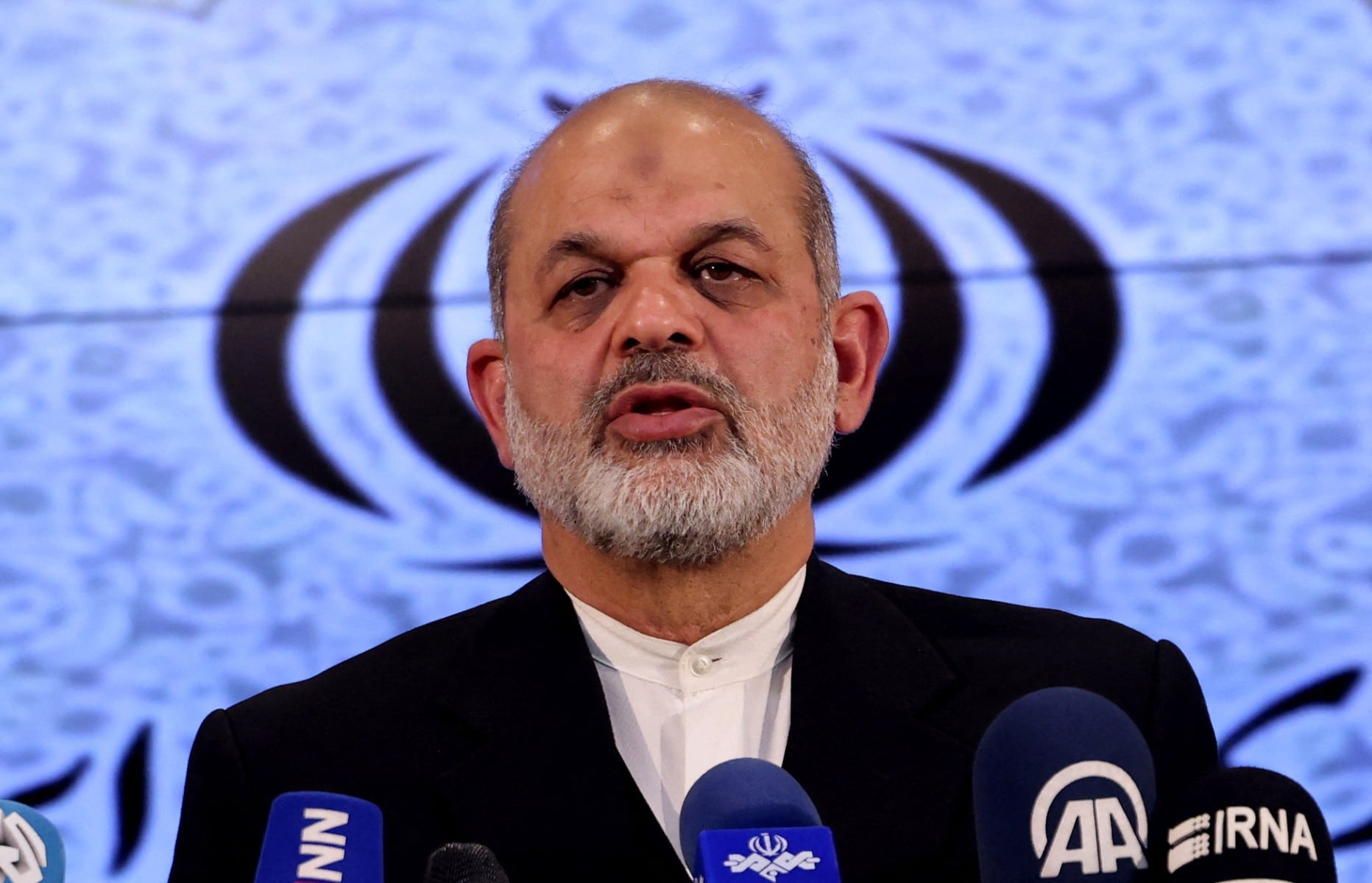
Ahmad Vahidi speaks during a press conference in Tehran on March 4, 2024
Photo Credit: AFP
This move came despite resistance from more moderate factions who had backed relatively centrist figures such as former Iranian president Hassan Rouhani, Hassan Khomeini, and Alireza Arafi.
Analysts warn of a more radicalised Iranian power structure emerging from the conflict.
Vali Nasr, a professor at Johns Hopkins School of Advanced International Studies, wrote on X, “Larijani’s replacement will be appointed by IRGC. With every assassination U.S. and Israel engineering greater radicalisation of Iran’s leadership. It will makes for a bleak future for Iran, Iranians, the region and ultimately makes it far more difficult for U.S. to disentangle itself from endless conflict in the region.”
Source link
[ad_3]

