
5 minutes ago
- copy link
Sheikh Hasina has resigned from the post of Prime Minister in Bangladesh. According to media reports, she has left the country and reached India. Bangladesh Army Chief General Waqar-uz-Zaman has said that the army will form an interim government.
The army has been deployed across the country including the capital Dhaka. Until some time ago, Sheikh Hasina was considered one of the most influential leaders in the world. She was called the messiah who would change Bangladesh’s economy.
India and China were trying to woo Bangladesh for investment. Now what has happened that Hasina, who has been in power for 15 years, is no longer safe in her own country and has come to India.
The story of Sheikh Hasina’s downfall began 2 months ago with the decision of the Dhaka High Court on 5 August. The story includes those 3 events of 60 days due to which she lost 15 years of power…
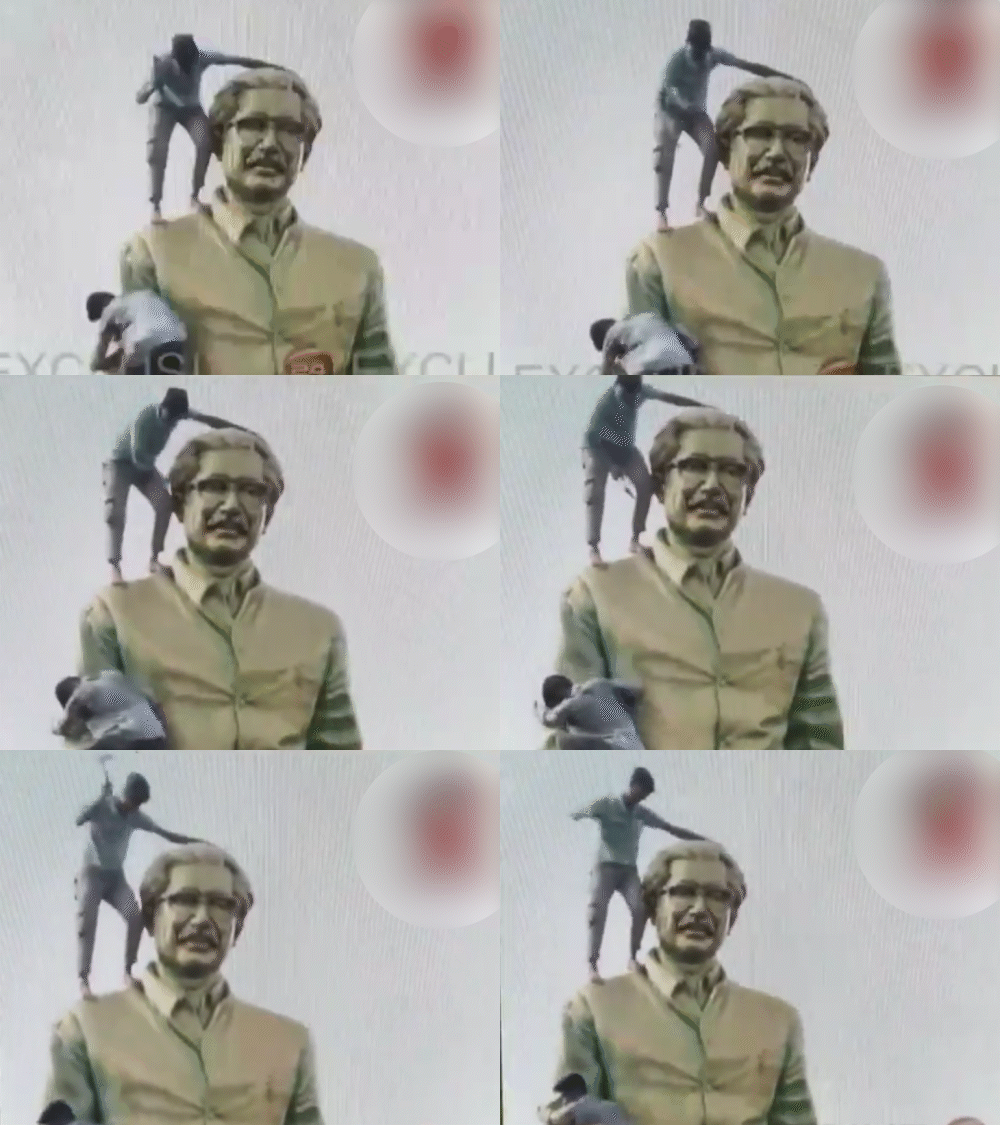
The protesters are breaking the statue of Bangladesh’s founding father Sheikh and Sheikh Hasina’s father, Mujiburahman, under whose leadership Bangladesh gained independence in 1971.
First reason: Dhaka High Court’s decision on reservation
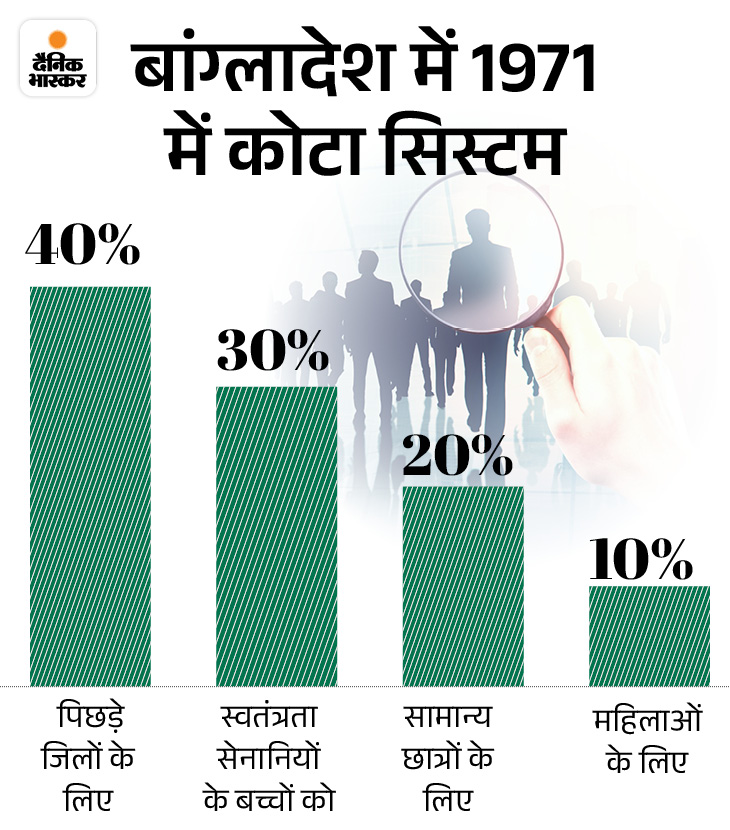
Bangladesh became independent in 1971. In the same year, 80% quota system was implemented there. According to the report of Bangladeshi newspaper The Daily Star, 30% reservation was given in jobs to the children of freedom fighters, 40% for backward districts, 10% for women. Only 20% seats were kept for general students.
After some protests, the reservation for backward districts was increased to 20% in 1976. General students got some benefit from this. 40% seats were allotted to them. In 1985, the reservation for backward districts was further reduced to 10% and a 5% quota for minorities was added. This led to 45% seats for general students.
Initially, only the sons and daughters of freedom fighters were given reservation. After a few years, the seats meant for the children of freedom fighters started to remain vacant. General students used to get the benefit of this. However, in 2009, the grandchildren of freedom fighters also started getting reservation.
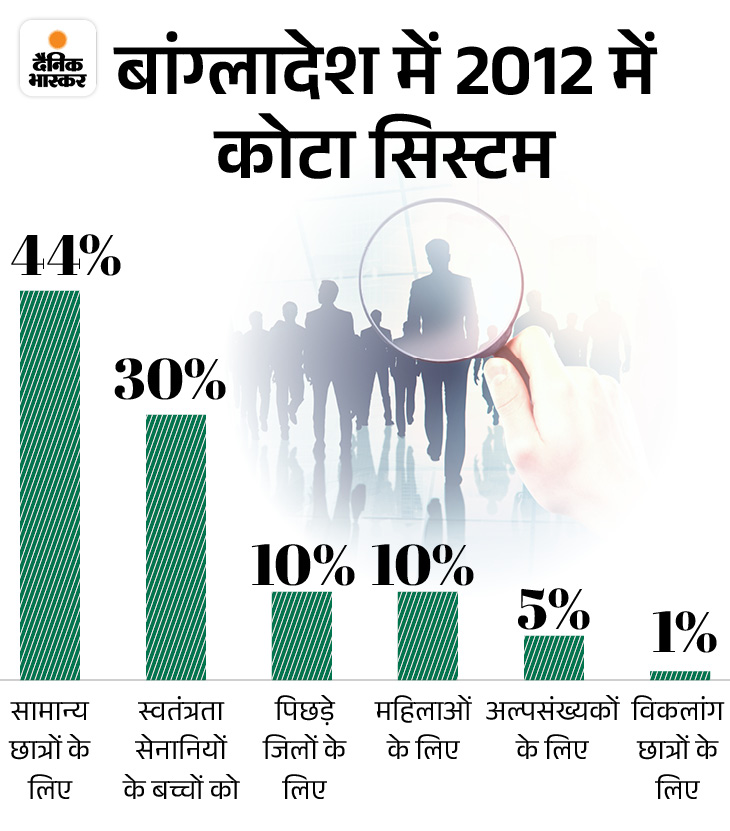
This increased the resentment of general students. In 2012, 1% quota was also added for disabled students. This increased the total quota to 56 percent. In 2018, after 4 months of student protests, the Hasina government abolished the quota system.
On June 5, the Dhaka High Court gave a verdict and ordered the government to restore the old quota system. The court said that the reservation that was available before 2018 should be implemented again. This angered the general category students and they took to the streets.
Second reason: Sheikh Hasina called the protesters pro-Pak Razakars
“If the sons and grandsons of freedom fighters don’t get reservation, will the grandchildren of Razakars get reservation?”
Bangladesh Prime Minister Sheikh Hasina said this in an interview given on July 14. The mere mention of Razakars turned the anti-reservation protest going on in Dhaka into a violent one. The protesting students set fire to the government TV channel to which PM Hasina had given the interview.
Slogans of ‘Tui ke, Ami ke Razakar, Razakar’ started reverberating in Dhaka University. The protests turned violent, in which more than 300 people lost their lives. According to media reports, Sheikh Hasina called the protesters Razakars to humiliate them and damage her image among the public. Calling the students protesting for their demands Razakars proved costly for Hasina.
Before the statement, Sheikh Hasina would not have thought that calling the protesters Razakars would cost her government so much that Bangladesh’s protest would come to the attention of the whole world. The students made the word ‘Razakar’ their weapon against the government. They gave the message to the public that how the government wants to prove the students preparing for the exam as ‘traitors’ just for making their demands.
Police are beating students to stop the protests in Bangladesh in July.
According to the Bangladeshi newspaper The Daily Star, after the Prime Minister, other leaders of his party also made similar statements, further inciting the anger of the protesting students. Social Welfare Minister Dipu Moni said – Razakars have no right to hold the sacred flag of Bangladesh.
At the same time, State Minister for Information and Broadcasting Mohammad Ali Arafat said that no demands of Razakars will be accepted. Due to such statements of the leaders, the protests of the agitated students intensified. Those whom the government wanted to prove as traitors i.e. Razakars, became heroes in the eyes of the public.
Who are the Razakars that Hasina mentioned?
It was the year 1971. Two days had passed since Pakistan surrendered in the war for Bangladesh. On the morning of 18 December, 125 corpses were found one after the other on the outskirts of Dhaka. All their hands were tied behind their backs.
It was becoming difficult to even identify them. Some of them were shot, some were strangled and some were stabbed with a knife attached to the rifle. All these 125 people were well-known personalities of Bangladesh.
These were among the 300 people who were held hostage by the Razakars so that in exchange for their lives they could force the Indian army, which was advancing steadily in Bangladesh, to agree to their demands. However, as soon as they sensed that Pakistan had surrendered, the Razakars killed all the hostages.
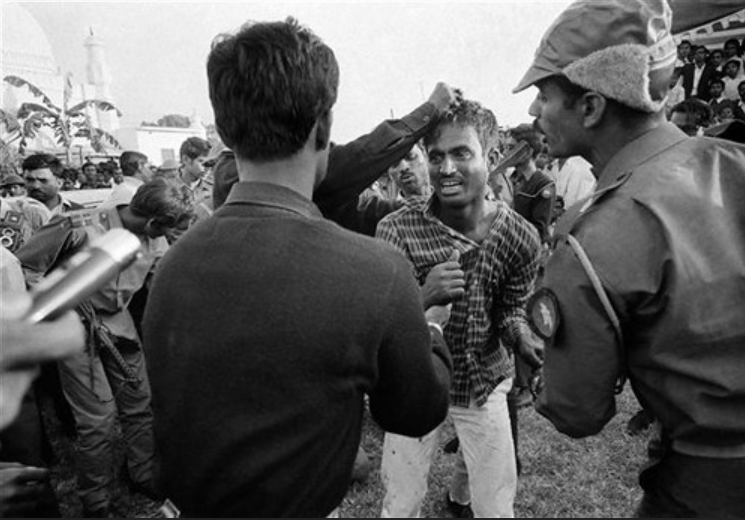
The Razakars had set up a factory and a mosque outside Dhaka. From here, they were firing bullets at the people who were reaching there to identify the bodies of their relatives.
As soon as the Indian army got information about this, they immediately reached there and freed the factory from the Razakars. More bodies of Bengalis were found near the factory, which were thrown in pits. The two Razakars who survived the action of the Indian Army surrendered. They confessed to killing 300 people.
During the 1971 war, being a ‘Razakar’ was not a common thing in Bangladesh. Razakar is an Arabic word, which means – volunteer or supporter. However, in Bangladesh it came to be considered very derogatory. Razakar came to mean traitors, who shed the blood of their own people in the 1971 war at the behest of Pakistani General Tikka Khan.
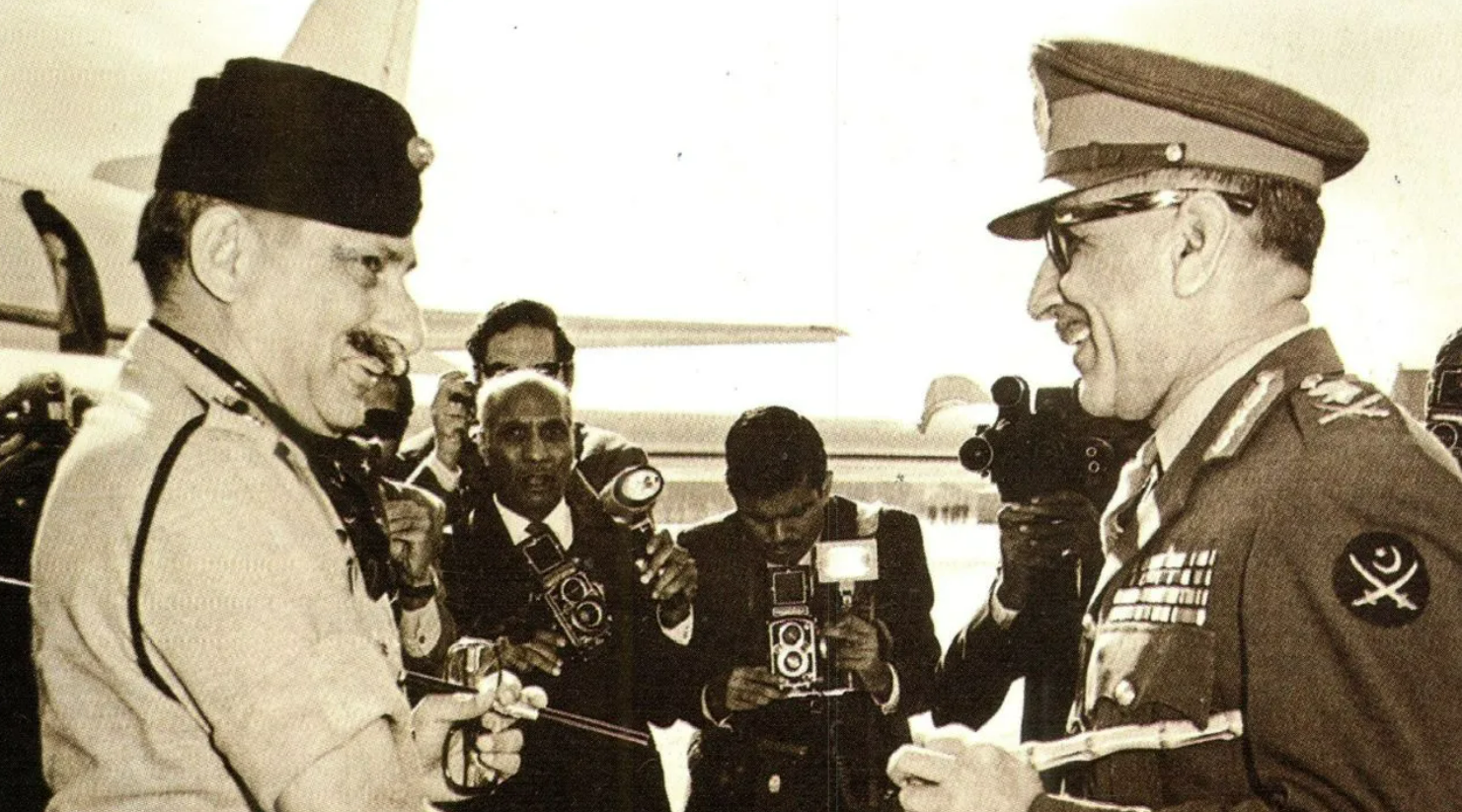
Tikka Khan with General Manekshaw in the picture. Sam Manekshaw had gone to Pakistan to talk about the exchange of some border areas after the war with Pakistan in 1971. At that time General Tikka was the Army Chief of Pakistan.
After reaching East Pakistan, Tikka Khan formed three types of militias to rein in the Mukti Vahini front protesting for independence. Al Badr, Al Shams and Razakars. On the orders of Tikka Khan, Jamaat-e-Islami leader Maulana Abul Kalam was made the leader of the Razakars. Initially, there were only 96 people in the Razakars army.
Later their number reached around 50,000. Razakars included Urdu speaking Muslims who went to Bangladesh from Bihar at the time of partition. They were supporters of Pakistan and did not want Bangladesh to be a separate country in the name of language.
In her book ‘Gambling with Violence: State Outsourcing of War in Pakistan and India’, Yelena Biberman has written quoting former Razakars that they were poor and illiterate. They believed that they were fighting for Islam.
Tikka Khan started direct military action against Mujibur Rahman’s Awami League. This operation, which started on 25 March, is also known as Searchlight. According to statistics, thousands of Bengalis were killed in the barbaric action of the Pakistani army and militia. Tikka Khan, who was called the hero of Rawalpindi, came to be known as the ‘Butcher of Bengal’ after this incident.
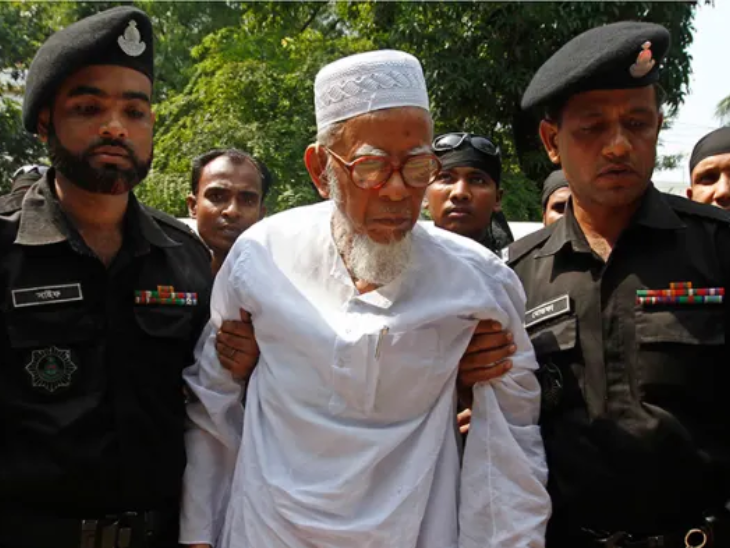
AKM Yusuf, one of the founding members of Razakars in Bangladesh. Yusuf died in custody in February 2014.
Third reason: Sheikh Hasina is silent on the death of students, shed tears on burning of metro
Sheikh Hasina visited Mirpur-10 metro station on 25 July to see the damage caused after the violent protests in Bangladesh. During this, Sheikh Hasina shed tears after seeing the vandalism in the metro station.
Sheikh Hasina was seen wiping her tears with tissue paper. However, she did not say anything even once about the death of more than 200 students in the protest.
Last month, six people leading the protest were held hostage by the Detective Branch for six days in the name of safekeeping. Of these, Nahid Islam, Asif Mahmood and Abu Bakar Majumdar were injured and were undergoing treatment in hospitals.
They were picked up from there. All of them were forced to make a video to withdraw the protest. When they were in custody, the Home Minister was claiming that they had said that they wanted to end the protest on their own. When the matter came to light, the anger of the protesters flared up even more. The protest grew so much that thousands of people took to the streets.
Like India, in Bangladesh too, government jobs are a major source of employment. In Bangladesh, every year more than 4 lakh students compete for 3 thousand Bangladesh Public Service Commission (BPSC) posts. For some years, due to lack of quota, merit was dominant in this, but now students are afraid that more than half of the seats will be eaten up by ‘quota holders’.
Now these students are demanding equal rights for all students. They say that there is no point in giving reservation to the grandchildren of freedom fighters. There should be merit in government jobs, not quota.

Source link
[ad_3]

