
New Delhi51 minutes ago
- copy link
EU has described today’s deal with India as the ‘Mother of All Deals’.
An agreement regarding Free Trade Agreement (FTA) can be announced today between India and European Union (EU). The EU has called it the ‘Mother of All Deals’.
European Commission President Ursula von der Leyen and European Council President Antonio Costa will talk to Union Commerce Minister Piyush Goyal in New Delhi regarding this.
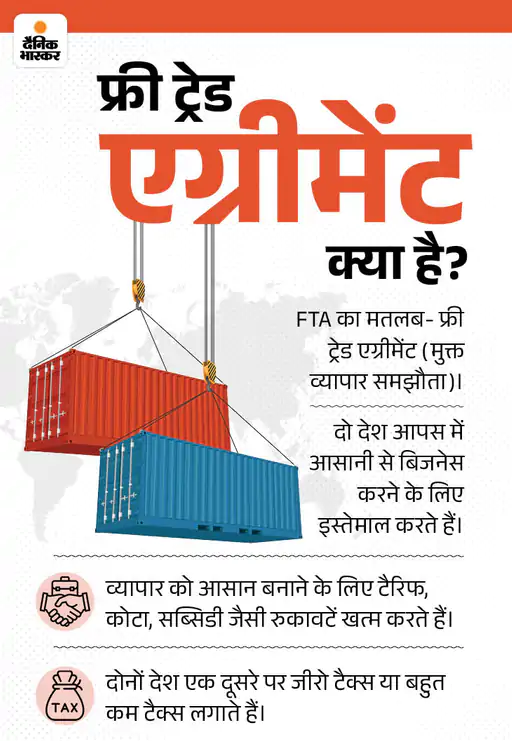
The objective of this FTA is to ease trade between India and EU. This will reduce business problems, small-medium range traders (MSMEs) will benefit, both markets will be opened and GI tagged products will be given protection. In simple language, this will be a toll-free route for business.
Know why it is being called Mother of All Deals?
- EU is the largest trade block in the world and India is a big economy. If both come together, a market of 200 crore people will be created and this deal will cover 25% of the world’s GDP.
- The world is looking for alternatives to America and China. In such a situation, this deal can make India a bigger manufacturing hub instead of China and trade with Europe will increase rapidly.
- Last year India-EU trade stood at Rs 12.5 lakh crore. After FTA, both the countries will get more access to each other’s markets and trade is expected to double.
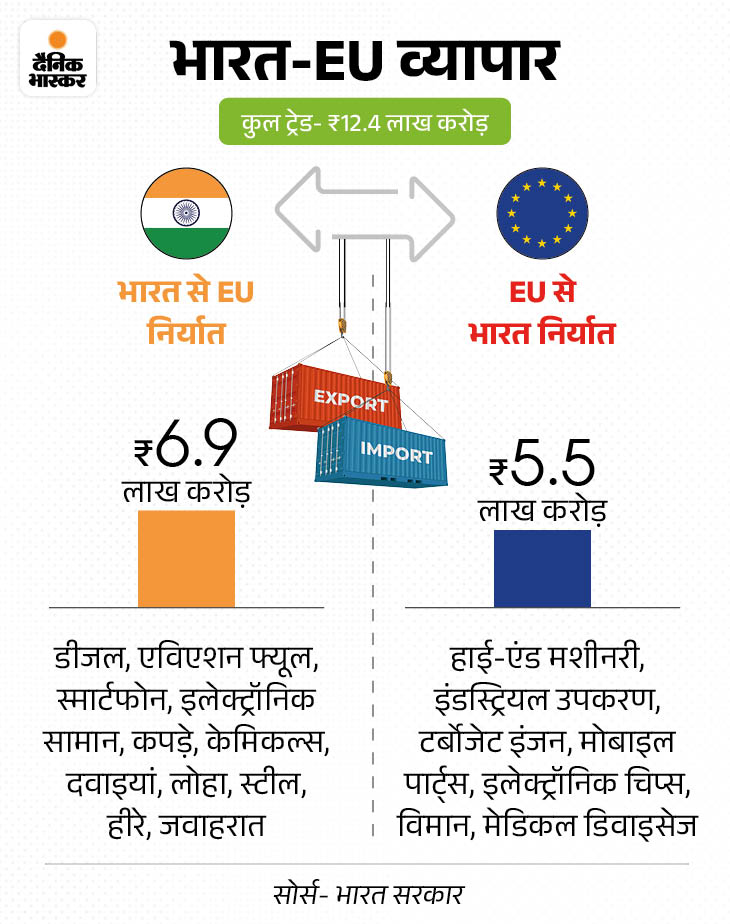
What benefit does India get from the agreement?
- 10% duty on Indian clothes, shoes and leather products may be reduced or eliminated. Indian garment, leather and footwear sector will benefit.
- EU countries like France, Germany can set up defense factories in India. With this, Indian arms companies can get access to EU defense funds.
- India’s trade in the pharma and chemical sector can grow by 20–30% every year, as drug approvals and regulations will become easier.
- India is expected to get relief from Europe’s carbon tax, which will benefit sectors like steel, aluminum and hydrogen.
- European liquor, cars and industrial products can be bought cheaper in India because the heavy tax on them will be reduced.
What benefit does Europe get from the agreement?
- Tax on liquor and wine coming from Europe may be reduced. This will make European liquor cheaper in India.
- It will be easier for European premium car companies like BMW, Mercedes, Porsche to sell in India.
- Currently, these cars attract 110% tax, which may come down to 40% after the deal and 10% in future.
- The Indian government has agreed to immediately reduce taxes on some European cars costing more than 15,000 Euros.
- European IT, engineering, telecom and business service companies will get more work in India.
India is the world’s third largest car market
India is the third largest car market in the world, but till now the share of foreign car companies has been less than 4% here. Due to high taxes, companies were able to sell only limited models. With reduced taxes, companies will be able to sell more models at cheaper prices and test the market, after which they can invest more in India.
This agreement is also expected to provide major benefits to India’s labour-based sectors like textiles, gems and jewellery, footwear, leather and handicrafts. India wants these products to enter the European market at low or zero tax. India had also placed this demand in its other trade agreements and has been successful in many places.
There has been a long-standing demand from the European Union to reduce taxes on cars and alcohol such as wine and spirits. India has already agreed to reduce taxes in such agreements with Britain, Australia and New Zealand.
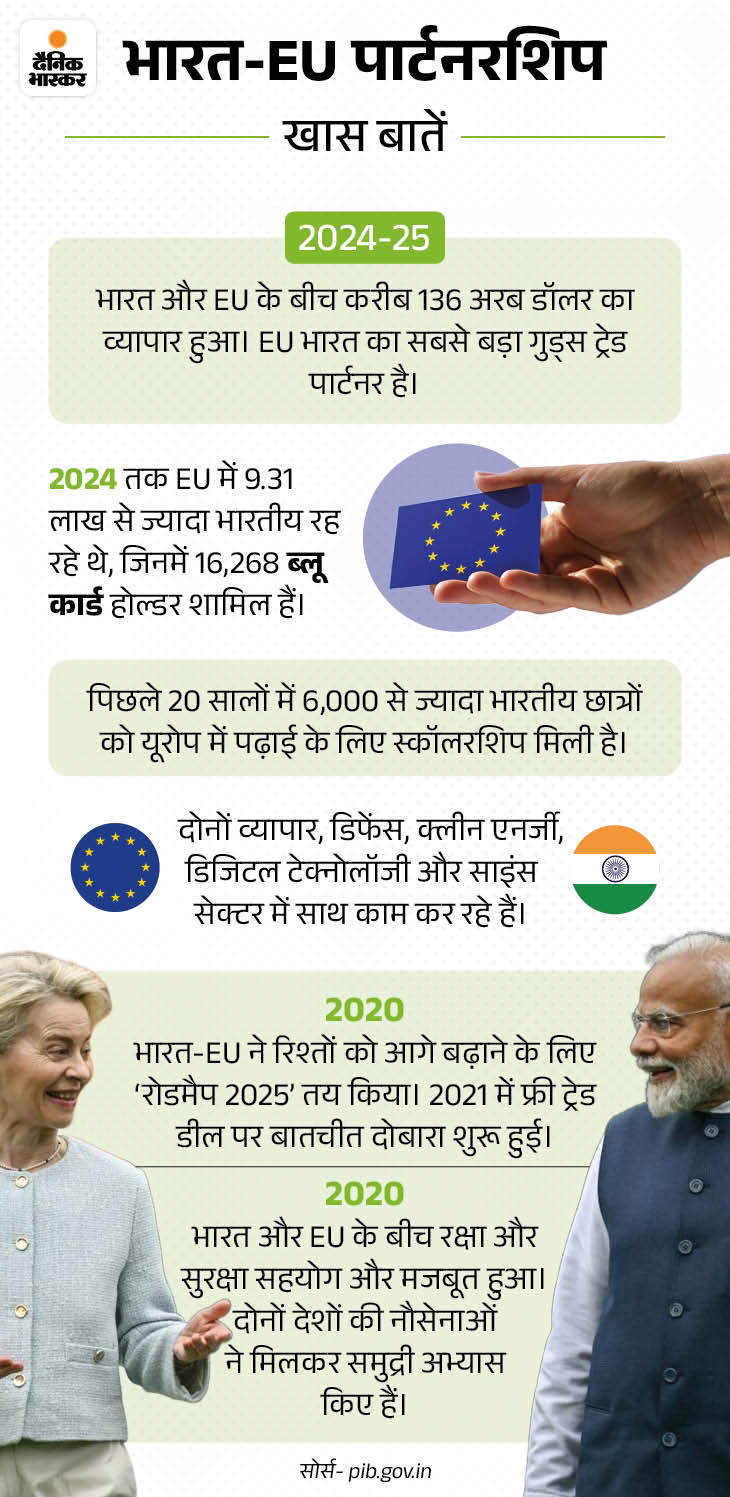
Possible challenges of this deal
According to media reports, the India-EU trade deal is beneficial, but both sides may have to face some challenges.
Challenges for India…
- If the tax on liquor and luxury cars is reduced, domestic companies will face tough competition from foreign brands.
- Following Europe’s strict rules (environment, labour, carbon tax) may increase the expenses of Indian companies.
- If the patent rules of medicines become strict then some essential medicines may become expensive.
- Smaller industries may find it difficult to compete with larger European companies.
Challenges for EU…
- Due to the arrival of cheap and mass-made products in India, some local industries of Europe may weaken.
- European companies will have to adapt to Indian rules and local conditions, which will increase costs.
- If more relaxations have to be given on visas and service sector, then concerns about domestic jobs may increase.
- Increasing trade with India will reduce the dependence of some EU companies on markets like China, which will lead to internal changes.
Dairy sector kept out of FTA
Sectors like agriculture and dairy have been kept out of this free trade agreement. India fears that European agricultural products may affect the income of its farmers. At the same time, EU is also cautious about its farmers, hence these issues have not been included in the agreement.
Apart from trade, India and the European Union are also negotiating investment protection agreements, GI tags and defense and security cooperation. During this period, consensus is also expected to be reached on movement of labourers, partnership in defense industry and increasing strategic cooperation.
European Commission President Ursula von der Leyen has said that a successful India makes the world more stable, secure and prosperous. He has described this agreement as historic and said that it will create a common market of about two billion people, which will be about a quarter of the world’s total GDP.
India-EU trade deal was stalled for 19 years
Negotiations on a trade deal between India and the EU began in 2007, but stalled in 2013. The reason was that both could not agree on many major issues. The EU wanted India to open up the farming and dairy sectors, but India feared that it would harm farmers. India was not ready even on the demand of reducing taxes on liquor and cars.
EU wanted to eliminate tariffs on more than 95% of its exports, whereas India was ready only for 90%. Apart from this, due to these 5 big reasons the deal got shelved…
India-EU trade deal was stuck on these 5 issues for two decades
- Farming and dairy issue: The EU wanted India to open its dairy market, but India feared that cheap European goods would hurt Indian farmers.
- Tax on liquor and cars: EU wanted India to reduce taxes on European liquor and cars, but India was not ready for it.
- Price of medicines: The EU wanted strict patent laws, which could make essential medicines expensive in India. For this reason India raised objection.
- Work Visa: India wanted its professionals to get easy work and business visas in Europe, but the EU did not agree to this.
- Interference in domestic matters: The EU also wanted to integrate issues like human rights and environment with trade, which India considered interference in its internal affairs.
Talks start again from 2021, 14 meetings held so far
In June-July 2021, talks about FTA between India and EU started again. From then till October 2025, officials from both sides held 14 meetings. The issues decided from 2007 to 2013 were also discussed in these meetings. It was decided that…
- There will be a plan to eliminate tariffs on more than 90% of the goods. All this will be implemented step by step in 5 to 10 years.
- There will be quota or gradual tariff reduction on sectors like agriculture, dairy, auto, liquor. They will be kept safe to a great extent in the initial phase. India was adamant on this earlier also.
India’s Commerce Secretary Rajesh Aggarwal said last week that talks on 20 out of 24 chapters of the deal between India and EU have been completed. There are reports that both sides can sign FTA after the 16th India-European Union Summit to be held in Delhi on January 27.
——————
Read this news also…
India-US trade deal could not be done because of Vance: Audio recording of US MP leaked, Trump also held responsible
The trade deal between India and America could not be done because of US Vice President JD Vance. This claim has been made by America’s Republican Senator Ted Cruz. An audio recording of the cruise has been leaked. Read the full news…
Source link
[ad_3]

