
New DelhiA few moments ago
- Copy link
Former CJI Justice JS Khehar attended the meeting held on 11 July.
A country, Joint Parliamentary Committee (JPC) formed on one election will hold a sixth meeting on Wednesday. In this meeting, Economist NK Singh and Professor Dr. Prachi Mishra of Economy will express their opinion in front of the panel.
NK Singh has been the chairman of the 15th Finance Commission. At the same time, Dr. Prachi Mishra is the head and director of the Isaac Center for Public Policy of Ashoka University.
Earlier, in the meeting held on July 11, there was a conversation with former CJI Justice JS Khehar and Justice DY Chandrachud. EMS Nachiappan, former chairman of the Parliamentary Standing Committee on law and justice, also expressed his opinion in the meeting.
A 39 -member JPC has been formed under the chairmanship of BJP MP PP Chaudhary to discuss the 129th Constitutional Amendment Bill for one country, one election. The job of JPC is to make widespread discussions on the bill, discussing with various parties and experts and making their recommendations.
Justice Chandrachud supported the bill in the 5th meeting
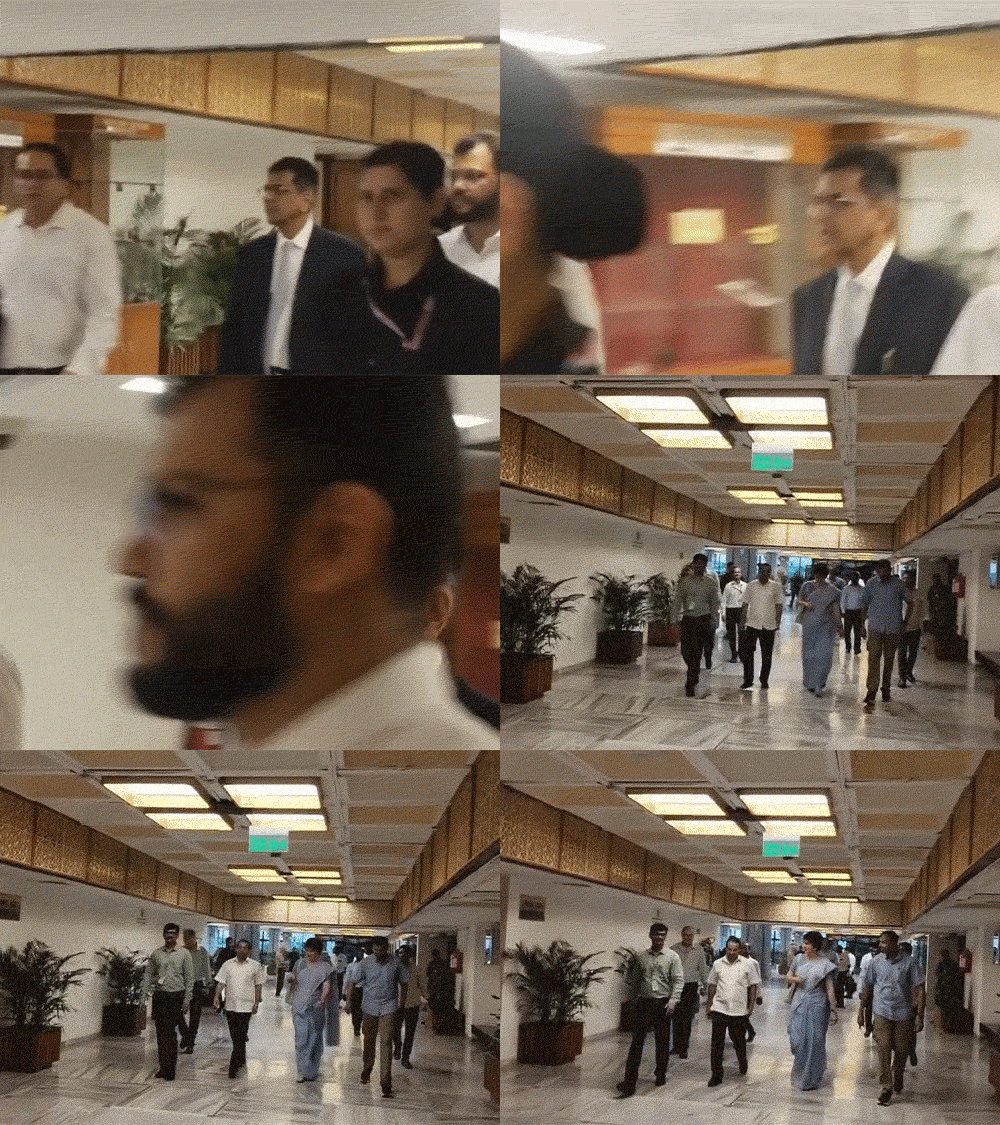
Apart from Justice JS Khehar, Justice DY Chandrachud also attended the 5th meeting of JPC held on July 11.
In the July 11 meeting, the bill was supported by former CJI Justice DY Chandrachud. He had said that the bill implementing the proposal to hold Lok Sabha-Vidhan Sabha elections simultaneously does not affect the basic structure of the Constitution. He said that there is a need to debate some provisions related to the powers of the Election Commission (EC) in the bill.
The former CJI said that in order to implement the provision of the bill, Parliament should decide any change in the tenure of the Legislative Assembly, not the Election Commission. Cases that have to be postponed can be done with the approval of Parliament.
First meeting- 8 January
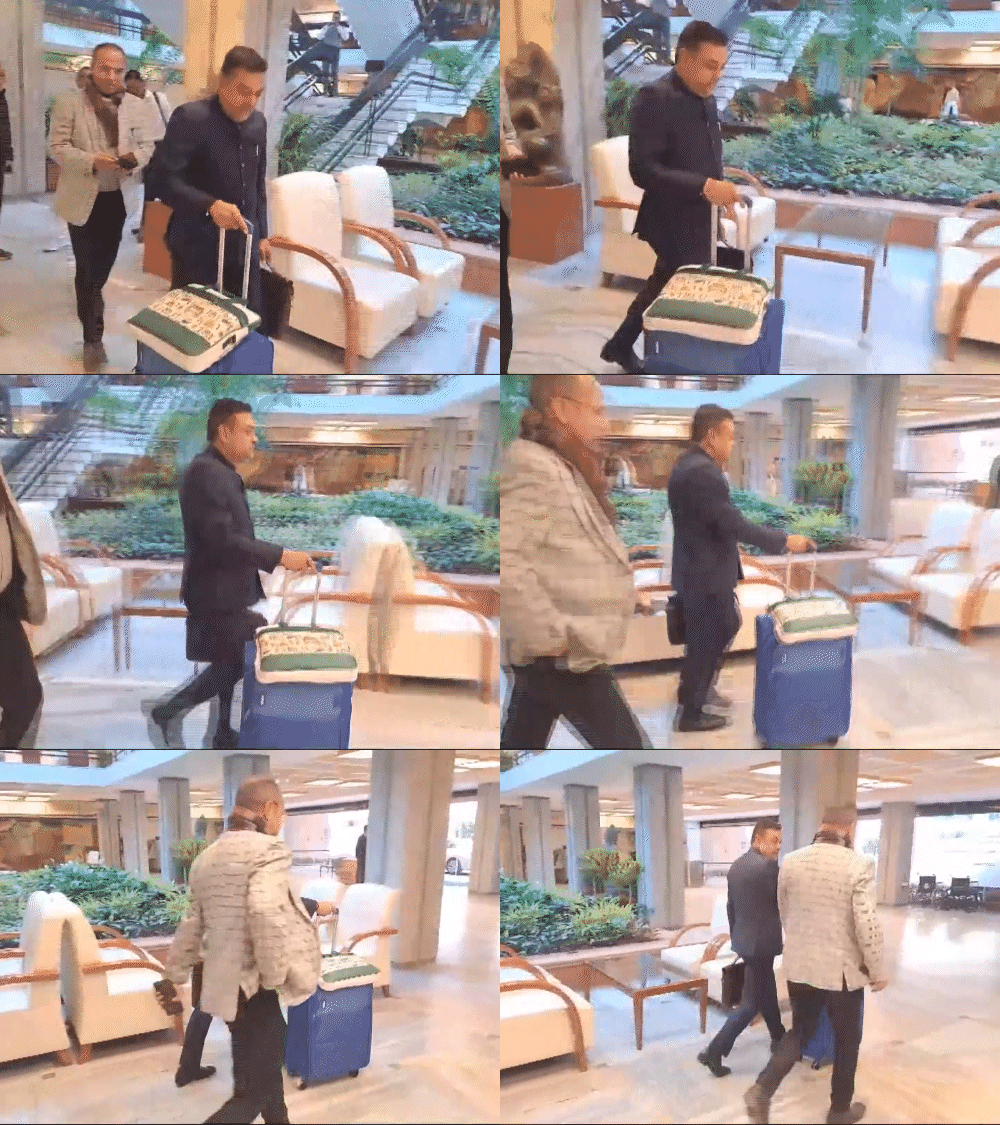
BJP MP Sambit Patra taking a report in the suitcase after the meeting.
The first meeting of JPC was held on 8 January. In this, all MPs were given a trolley with more than 18 thousand page reports. This includes the Kovind Committee report in Hindi and English and 21 copies of the attachment. It also includes soft copy. Read full news …
Second meeting- 31 January
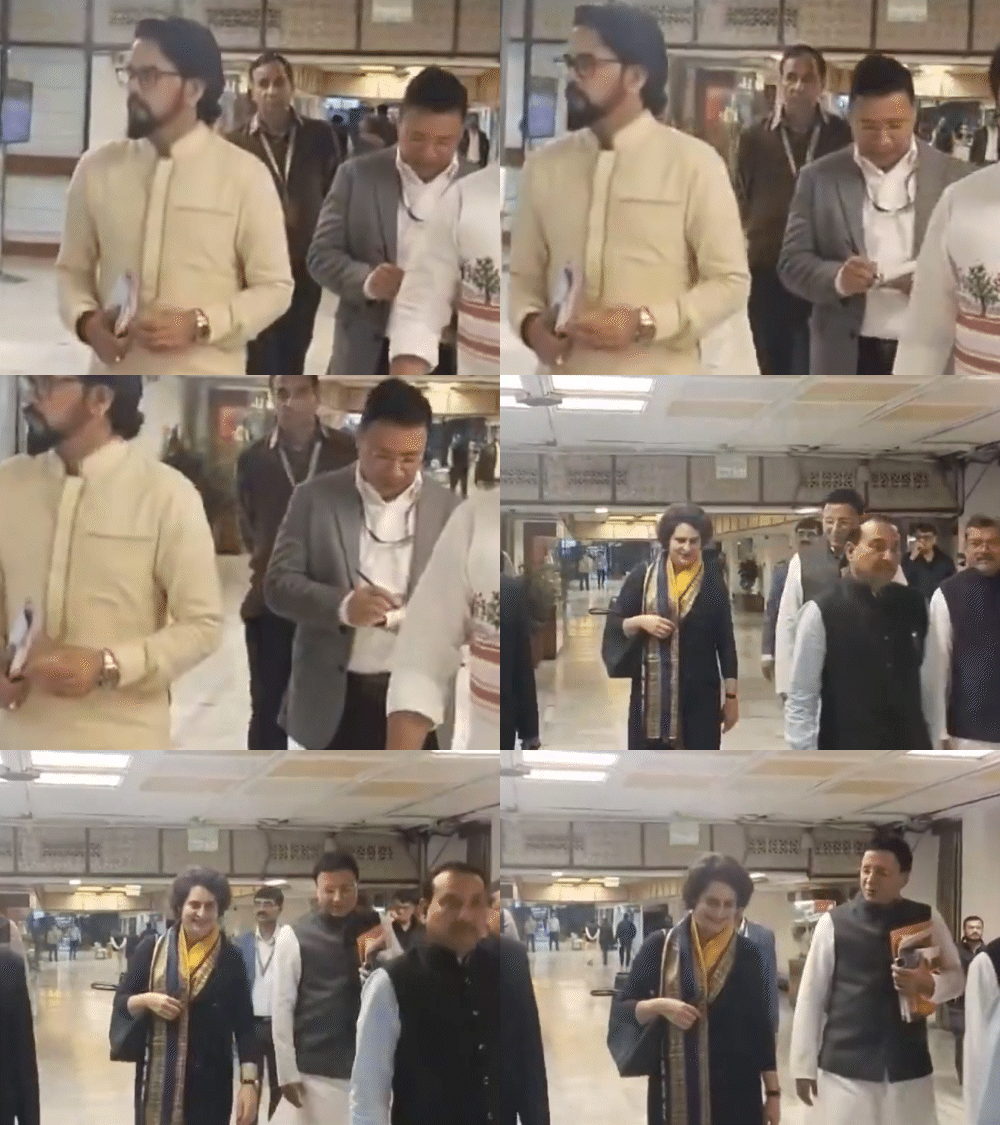
Priyanka Gandhi and Anurag Thakur reached the second JPC meeting.
The second meeting was held on 31 January 2025 on the 129th Constitution Amendment Bill. In this, the committee made a list of stake holders to take suggestions on the bill. This includes the Supreme Court and the former Chief Justice, Election Commission, political parties and state governments of the country. Read full news …
Third meeting- 25 February
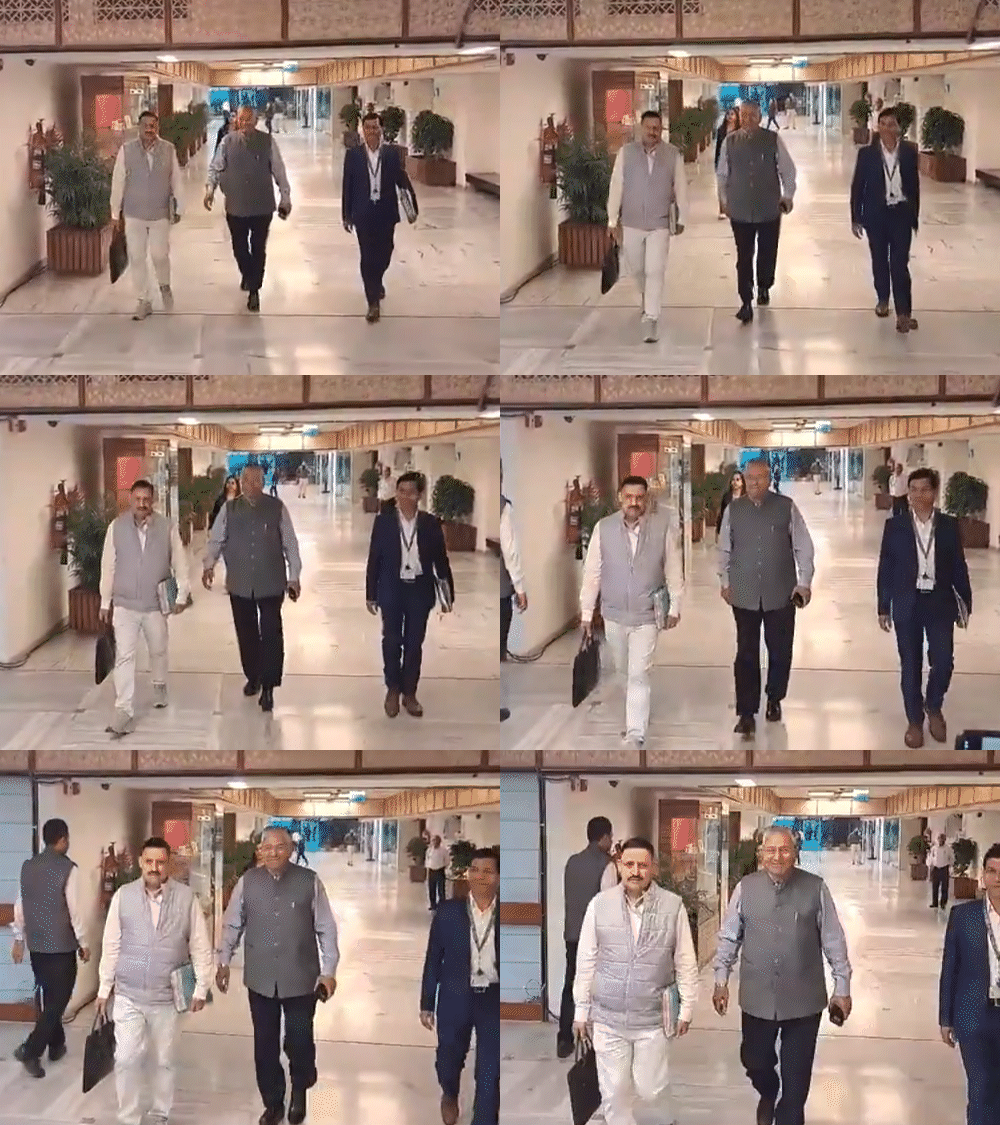
Congress MPs Priyanka Gandhi Vadra, Randeep Surjewala and other leaders had come to attend the JPC meeting.
The third meeting of the committee was held on 25 February. In this, former Chief Justice Uday Umesh Lalit, former Chairman of Law Commission, Rituraj Awasthi, gave suggestions in front of 4 Law Experts Committee. Read full news …
Fourth meeting- 26 March
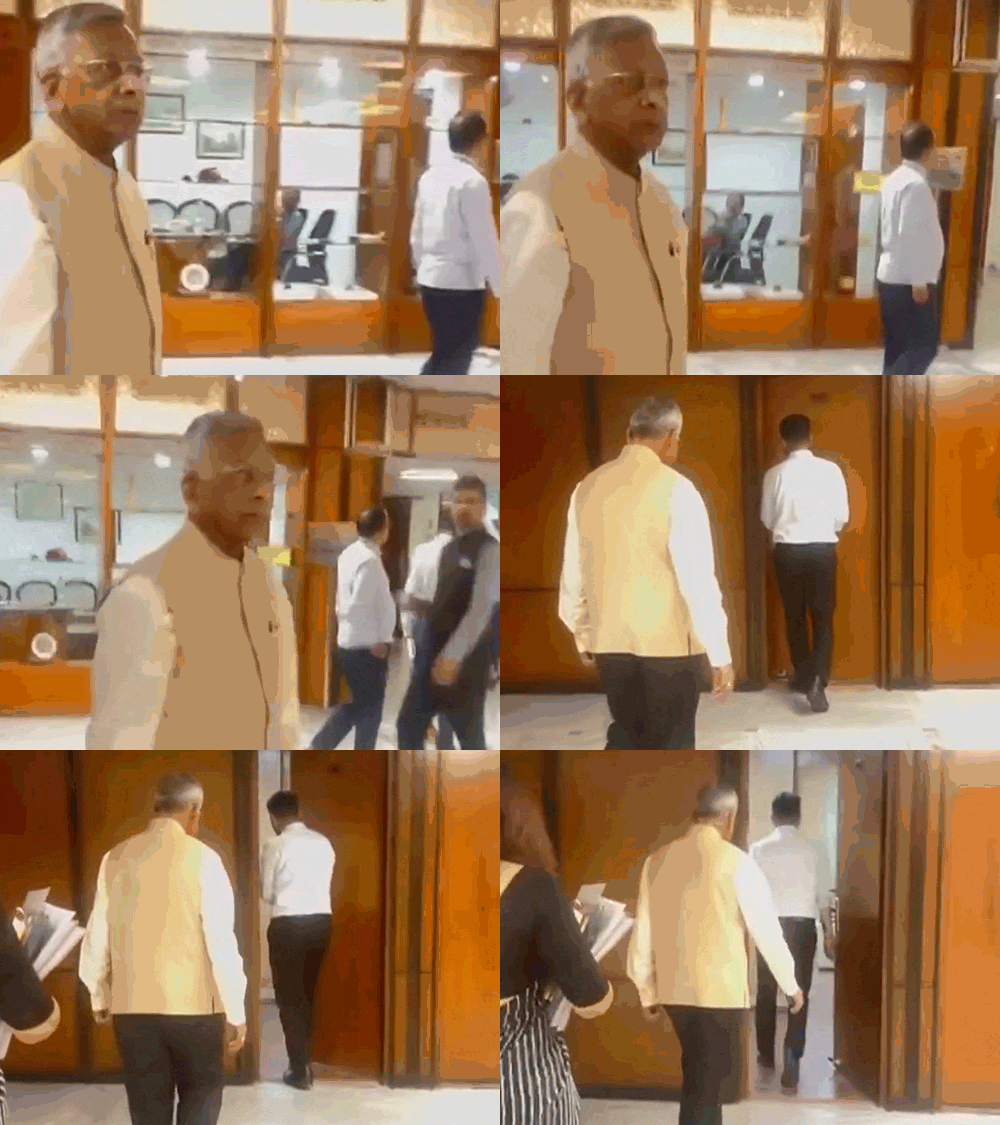
India’s Attorney General R Venkatarmani reached Parliament House for a JPC meeting on the ‘one election’ bill.
On March 26, the Joint Parliamentary Committee (JPC) had a fourth meeting on Tuesday. In this, others including Attorney General R Venkatramani, former Chief Justice of Delhi High Court DN Patel, JPC member Priyanka Gandhi Vadra and others attended.
According to sources, Attorney General Venkataramani had told JPC- there is no need for any amendment in the proposed laws. The Bills to hold elections simultaneously do not affect any feature of the Constitution. These are correct from the point of view of law. Read full news …
What is one country-one election… There are elections for Lok Sabha and state assemblies at different times in India. One country-one election means holding elections of Lok Sabha and state assemblies simultaneously. That is, voters will vote on the same day, at the same time to choose members of Lok Sabha and State Assembly.
The Lok Sabha and Assembly elections were held simultaneously in 1952, 1957, 1962 and 1967 after independence, but in 1968 and 1969 several assemblies were dissolved prematurely. The Lok Sabha was also dissolved in December 1970. Because of this, the tradition of one country-one election was broken.
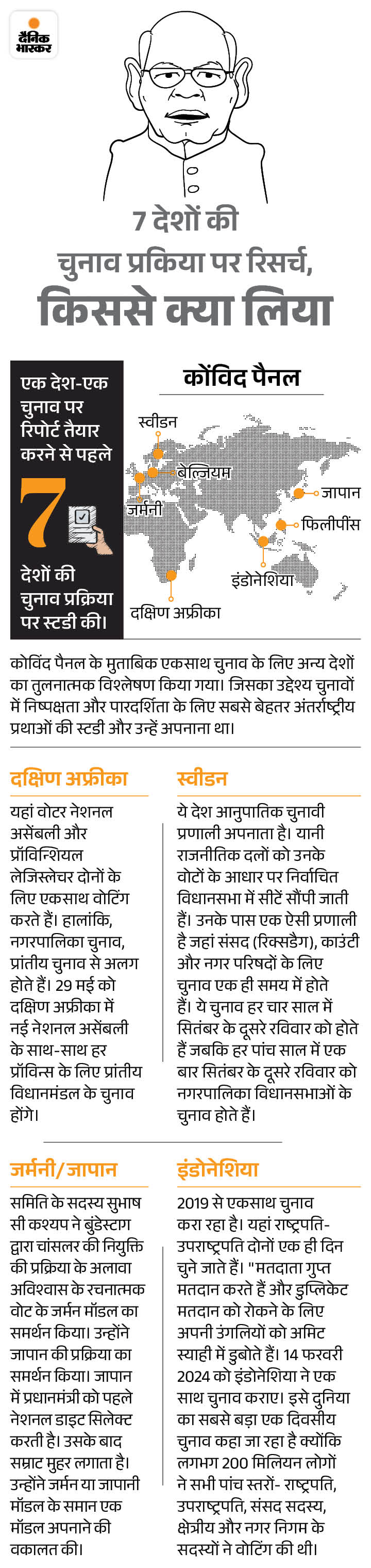
4 big benefits of holding elections together
Ramnath Kovind Committee has given these arguments in favor of holding elections together in its report …
1. Continuation will come in governance: Due to the ongoing cycles of elections in different parts of the country, political parties, their leaders and governments are focused on elections. By conducting elections simultaneously, the focus of governments will focus on developmental activities and implementation of public welfare policies.
2. Officers will be able to focus on work: Due to the reasons for the election, adequate number of personnel of several departments including police have to be deployed. With simultaneous elections, the need for repeated deployment will be reduced, so that government officials will be able to focus on their basic liability.
3. Policy will stop paralysis: Regular administrative activities and development works are disrupted by the implementation of the Model Code of Conduct during elections. Elections together will reduce the period of prolonged implementation of the model code of conduct, which will reduce the policy paralysis.
4. Financial burden will decrease: Elections together can reduce the expenditure significantly. Whenever elections are held, manpower, equipment and management of safety measures cost huge spent. Apart from this, political parties also have to spend a lot.
These figures support together elections
• 676 days of code of conduct remained in force in India during 2019-2024, ie about 113 days every year.
• According to an estimate in the 2024 Lok Sabha elections alone, about 1 lakh crore rupees were spent.
——————————————
Read this news related to the case …
One country-one election is not a violation of the basic structure of the constitution, former CJI Chandrachud gave a written opinion to the Parliamentary Committee
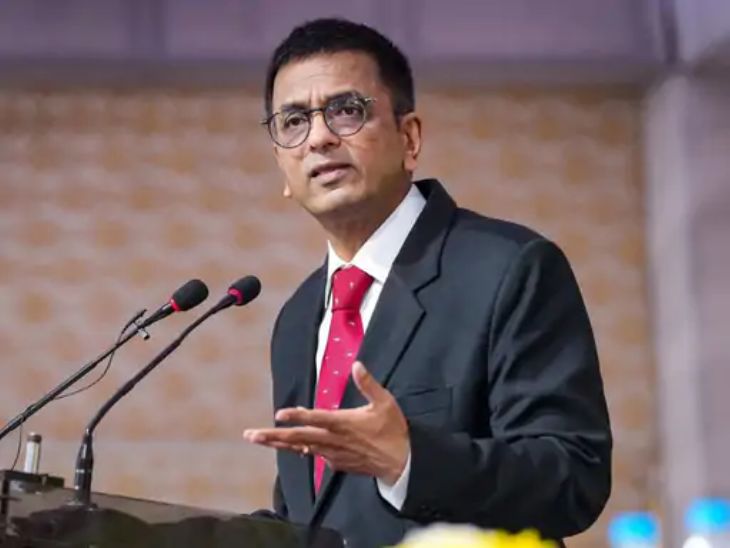
Former Chief Justice of India (CJI) DY Chandrachud said, “Elections of Lok Sabha and Assembly together are not a violation of the basic structure of the Constitution.” However, he has expressed concern over the powers given to the Election Commission (ECI) in the proposed bill. Read full news …
Source link
[ad_3]

